2026 Best Dispensary Display Cases for Global Buyers
Choosing the right dispensary display cases requires more than attractive glass and polished metal. Global buyers need secure construction, clear product visibility, efficient lighting, and reliable shipping support. A case should protect merchandise while helping customers understand size, quality, and pricing. Small details matter, such as soft-close hinges, adjustable shelves, tamper-resistant locks, and fingerprints that do not linger.
Retail fixture consultant James Perry explains, “A display case should protect the product without hiding its value.” That principle guides this 2026 overview. The best dispensary display cases combine practical security with a calm, professional shopping experience. Tempered glass, powder-coated steel, low-heat LEDs, and modular interiors can support daily use. However, no single design fits every market.
Global conditions vary. Electrical standards, accessibility expectations, import requirements, and retail policies must be checked before ordering. A beautiful case can still fail if replacement parts arrive slowly. That happens. Buyers should request drawings, material specifications, warranty terms, and installation instructions. They should also confirm whether the supplier has experience with international packaging and customs documentation.
This guide compares display solutions for pharmacies, wellness retailers, and other regulated commercial environments. It does not recommend prohibited products or bypass local requirements. Instead, it focuses on lawful merchandising, durable construction, and responsible customer service. Some recommendations may seem obvious, but rushed purchasing often overlooks them. Measure the room twice. Review the workflow. Then choose dispensary display cases that support safety, clarity, and long-term value.
2026 Market Context: Grand View Research’s 23.1% Cannabis CAGR
Grand View Research reports a 23.1% compound annual growth rate for the global legal cannabis market from 2024 to 2030. That expansion is changing retail fixtures. Dispensary display cases now need to support controlled access, clear product visibility, and consistent customer education. For global buyers, the case is part of the operating system, not simple furniture.
A practical case uses laminated or tempered glass, a lockable frame, and adjustable shelves. UV-filtering glass can help protect sensitive packaging from strong retail lighting. Even illumination reduces glare and improves label reading. Small details matter. Rounded edges, stable hinges, and accessible shelf heights support safer daily use. Buyers should also verify local electrical, fire, accessibility, and material requirements before importing.
The 2024 Global State of Tobacco Harm Reduction report highlights the continuing importance of regulated, transparent retail environments. It does not define display-case specifications, but its emphasis on information access is relevant. Clear panels and uncluttered layouts help staff explain legal product information without overstating benefits. I would avoid designing around maximum capacity alone. A crowded cabinet looks efficient, yet it can weaken inspection and customer understanding. The better choice may be a modular case with replaceable seals and serviceable lighting. It costs more initially. That trade-off deserves calculation. Conditions vary widely between markets, and one universal specification is unlikely to remain reliable.
2026 Best Dispensary Display Cases for Global Buyers
Cannabis market growth context based on the 23.1% CAGR cited from Grand View Research. The chart uses a normalized market-size index, with 2026 set to 100; later values are calculated using compound annual growth and do not represent company or brand revenue.
Interpretation: A rapidly expanding market can increase demand for secure, modular, compliant, and visually merchandised dispensary display cases. Index values are illustrative projections derived from the stated 23.1% CAGR.
Display Case Types: Glass Towers, Counter Units, and Modular Systems
2026 Best Dispensary Display Cases for Global Buyers
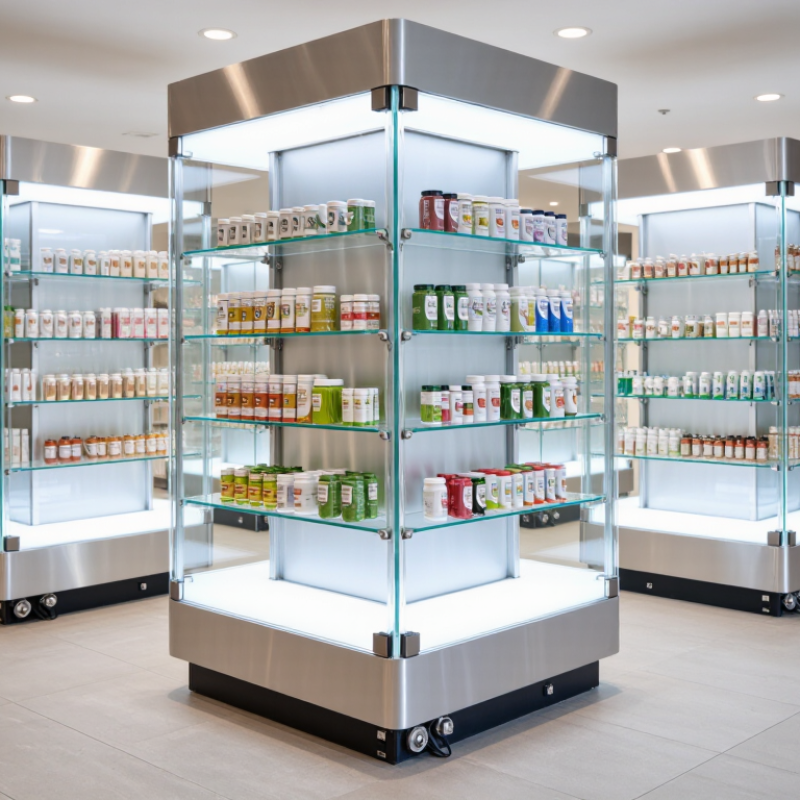
Glass towers, counter units, and modular systems serve different retail jobs. Grand View Research’s 2024 retail shelving analysis projects steady market growth through 2030, driven by flexible store layouts and visual merchandising. A glass tower suits premium presentation. Its vertical shelves create clear sightlines and protect packaged, lawfully sold goods from frequent handling. Use laminated or tempered safety glass, compliant with recognized standards such as EN 12150 or ANSI Z97.1. Leave enough space between shelves. Crowded displays look cheaper and slow customer decisions.
Counter units work better for compact stores and staff-guided service. A 900-millimeter counter, lockable drawers, and a shallow glass top can keep frequently requested items visible without blocking conversation. Modular systems offer easier expansion. Panels, shelves, lighting tracks, and lockable compartments can be replaced separately. The U.S. Department of Energy reports that LED lighting uses at least 75% less energy than incandescent lighting, making low-heat LEDs practical for enclosed cases. Warm light may improve material appearance, but excessive brightness creates reflections. I would test samples under real store lighting before ordering.
Global buyers should confirm load ratings, shipping protection, replacement hardware, and local safety requirements. Small details matter. One weakness remains: modular fittings can loosen after repeated adjustment. A six-month inspection schedule is sensible, though many procurement plans overlook it. Reliable suppliers should provide drawings, material certificates, cleaning guidance, and measurable lead times. Experiences from installation teams often reveal more than polished catalog images.
Security Benchmarks: EN 14450, EN 1143-1, and UL 962 Standards
2026 Best Dispensary Display Cases for Global Buyers
Security Benchmarks: EN 14450, EN 1143-1, and UL 962 Standards
A professional display case should protect products, staff, and visitors. EN 14450 is a practical benchmark for secure storage units. It covers tested resistance levels, commonly S1 and S2. Buyers should request the exact certificate, grade, and tested configuration. A strong-looking frame is not proof of compliance.
For higher security demands, EN 1143-1 provides a more demanding testing framework. It classifies safes and secure storage units by resistance grade. The test considers construction, locking systems, anchoring, and resistance to defined attack methods. A case adapted from a certified unit may lose its original performance. That detail is easy to miss.
UL 962 addresses electrical safety for commercial furnishings. It can help evaluate powered display cases with lighting, wiring, switches, or charging features. However, it does not replace burglary-resistance testing. Buyers should review electrical markings, installation instructions, heat management, and service access. Small cable openings can become weak points. They deserve attention.
On-site experience also matters. Check door alignment, hinge protection, glass retention, and floor anchoring. Ask how the lock performs after repeated daily use. Documentation often looks complete, yet installation records may be missing. That gap should be corrected before purchase. A careful buyer compares the certificate with the final case, not just the sales drawing.
Accessible Merchandising: ADA’s 36-Inch Counter and 15–48-Inch Reach
2026 Best Dispensary Display Cases for Global Buyers
Accessible merchandising starts with the counter, not the product arrangement. The ADA 2010 Standards set a 36-inch maximum height for accessible sales and service counters. The accessible section should provide at least 36 inches of clear length. Its approach area also needs usable knee and toe clearance. These details affect how customers browse, ask questions, and complete purchases.
Reach range matters inside the case. ADA Section 308 defines an unobstructed forward reach from 15 to 48 inches above the floor. For many users, that range determines whether labels, samples, or digital information remain independently usable. The CDC reports that about one in four U.S. adults has a disability. The World Health Organization estimates that 1.3 billion people experience significant disability globally. Those figures make accessibility a major market requirement, not a small design preference.
A strong 2026 display case should keep high-interest items between 15 and 48 inches. Use clear glazing, low-glare lighting, and readable labels near eye level. Keep the 36-inch counter zone open, with no payment device blocking the approach. A compliant case can still feel frustrating. Designers sometimes measure the counter, then ignore the customer’s elbow, mobility aid, or viewing angle. That is the weak point. Test a full-size mockup with different users before production. Recheck hardware after installation, because hinges and raised platforms can quietly reduce reach and clearance. ADA guidance remains essential, but local accessibility rules may be stricter.
Global Buyer Scorecard: Visibility, Capacity, Compliance, Cost, and Lead Time
For 2026, the best dispensary display case should be judged by a practical buyer scorecard: visibility, capacity, compliance, cost, and lead time. Clear, low-glare panels should show products from standing eye level, while adjustable shelves prevent wasted vertical space. Measure usable capacity, not advertised capacity. That difference matters.
Compliance needs local verification. The World Bank’s 2023 Logistics Performance Index evaluates customs, infrastructure, and timeliness on a one-to-five scale. Buyers should request documented materials, locking performance, electrical safety records, and accessibility details. ISO’s 2023 survey recorded more than 1.26 million ISO 9001 certificates worldwide, but certification alone cannot prove every supplier’s manufacturing quality. Ask for recent inspection evidence.
Cost includes installation, maintenance, lighting replacement, freight, and possible redesign. UNCTAD’s Review of Maritime Transport 2024 states that ships carry over 80% of global trade by volume, so shipping schedules can quickly affect launch dates. Request a landed-cost quotation and a written production timeline. Short lead time sounds attractive. It may indicate limited customization. A perfect scorecard is unrealistic; I would assign weighted scores and leave space for judgment. Visibility might receive 25%, compliance 25%, capacity 20%, cost 15%, and lead time 15%. Percentages should change when local regulations or store traffic change.
2026 Best Dispensary Display Cases for Global Buyers - Global Buyer Scorecard: Visibility, Capacity, Compliance, Cost, and Lead Time | Display Case Type | Visibility
Score / 5 | Typical Capacity | Compliance Readiness | Typical Cost
USD / Unit | Typical Lead Time | Best Use Case | Overall Score
/ 5 |
| Tempered-Glass Wall Case Lockable, fixed installation | 4.5 | 30–60 retail packages | High | $550–$1,200 | 4–8 weeks | High-visibility product walls and controlled-access retail areas | 4.3 |
| Countertop Display Case Compact, customer-facing format | 4.0 | 8–20 retail packages | Medium–High | $180–$500 | 2–5 weeks | Checkout zones, accessories, small-format products, and limited floor space | 4.1 |
| Freestanding Glass Tower 360-degree product access view | 4.8 | 40–90 retail packages | High | $900–$2,000 | 5–10 weeks | Premium merchandising, central aisles, and category separation | 4.4 |
| Modular Gondola Case Configurable shelving system | 4.2 | 60–140 retail packages | High | $1,200–$3,000 | 6–12 weeks | High-volume stores requiring flexible layouts and future expansion | 4.2 |
| Illuminated Display Case Integrated LED lighting | 4.9 | 25–70 retail packages | High | $750–$1,800 | 5–10 weeks | Brand-neutral premium presentation and low-light retail environments | 4.3 |
| Secure Drawer Display Unit Lockable pull-out compartments | 3.6 | 20–80 retail packages | Very High | $1,000–$2,500 | 6–12 weeks | Inventory control, high-value items, and restricted-access storage | 4.1 |
| Refrigerated Display Case Temperature-controlled storage | 4.0 | 20–60 retail packages | Very High | $1,800–$4,500 | 8–16 weeks | Temperature-sensitive products where local rules require controlled storage | 3.9 |
| Mobile Locking Display Case Wheeled, repositionable format | 4.1 | 25–70 retail packages | Medium–High | $650–$1,600 | 4–9 weeks | Pop-up retail, seasonal layouts, and stores needing frequent reconfiguration | 4.0 |
Buyer reference: Capacity estimates assume standard retail packaging and adjustable shelf spacing. Prices are indicative 2026 international purchasing ranges before freight, duties, installation, electrical work, and local taxes. Compliance readiness refers to common features such as lockable access, tempered safety glass, stable anchoring, visibility of merchandise, and compatibility with local retail-security requirements; buyers should verify applicable regulations in the destination market.