• Monday

    9:00-5:00

  • Tuesday

    9:00-5:00

  • Wednesday

    9:00-5:00

  • Thursday

    9:00-5:00

  • Friday

    9:00-5:00

  • Saturday

    9:00-4:00

  • Sunday

    CLOSED

10 Best Crystal Scented Candle Suppliers Worldwide

A Crystal Scented Candle combines fragrance, light, and decorative appeal. Its appearance may attract attention, but the details behind the product matter just as much. Buyers should compare wax blends, fragrance options, wick materials, vessel quality, and available sizes. A smooth finish can look impressive on a shelf. A weak wick or uneven melt can quickly change that impression.

This guide introduces ten suppliers serving different markets and business needs. Their strengths may include custom scents, private labeling, distinctive crystal-inspired designs, or flexible order quantities. Supplier claims deserve careful review. Ask for samples, clear specifications, burn-test information, and current safety documents relevant to your market. Check packaging, minimum order quantities, production timelines, and communication before committing. A glossy catalog is not proof of consistent quality. No supplier is perfect, and a promising sample may not represent every production batch. That is worth remembering. Use the comparisons as a starting point, then confirm details directly with each company. The right partner should offer attractive products and dependable, transparent service.

10 Best Crystal Scented Candle Suppliers Worldwide

Understanding Crystal Scented Candles and Their Global Market

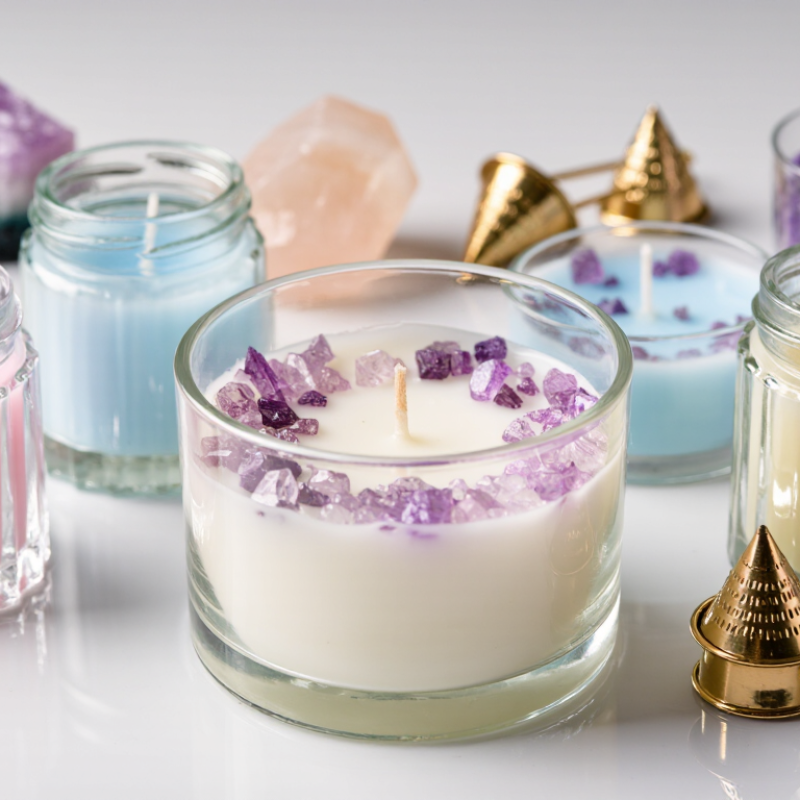
Crystal scented candles combine fragrance, warm light, and decorative minerals in one lifestyle product. The crystals usually sit on the candle surface or around the vessel. They are mainly visual elements, not ingredients that improve the scent. A well-made candle should use stable wax, a centered wick, and a heat-resistant container. Loose stones can shift during burning, which may affect safety and appearance.

The global market is expanding through home décor, wellness gifting, and online retail. Buyers often seek calming scents, natural textures, and attractive packaging. Preferences differ by region. Floral fragrances may appeal in one market, while woody or citrus notes perform better elsewhere. Reliable suppliers should provide wax details, fragrance specifications, burn-test records, and clear care instructions. Product labels should identify the materials accurately. Vague claims weaken trust.

Supplier evaluation needs more than attractive photographs. Check batch consistency, wick performance, packaging strength, and communication speed. Ask whether the crystals are securely placed and whether the vessel remains stable during use. Independent laboratory documents can support safety claims, but paperwork alone is not enough. Sample testing matters.

The category is not perfectly standardized. Some listings still describe ordinary decorative stones as rare or energetic materials without evidence. That language may attract attention, yet it can mislead customers. A careful supplier explains what is known and what remains uncertain. Even experienced buyers can overlook fragrance sensitivity, shipping heat, or damaged stones. Global sourcing rewards patience, practical testing, and honest product descriptions.

Criteria for Evaluating Crystal Candle Suppliers

Choosing a crystal scented candle supplier requires more than comparing product photos. Ask how the crystals are selected, cleaned, and secured in the wax. Request clear product specifications, including vessel size, wax type, fragrance details, and burn-time testing methods. A supplier who can explain these details plainly is easier to evaluate.

Check samples under normal conditions. Note whether the scent feels balanced in a small room, whether the wick burns evenly, and whether stones shift or obstruct use. Ask for batch records and quality-control procedures, not just polished catalog images. Small variations may occur with natural materials. That is worth discussing.

Communication matters. Test how quickly the supplier answers a specific question about packaging or lead times. Review sample packaging for chipped stones, loose lids, or wax marks. A neat sample helps, but it proves little on its own. Compare written terms for minimum orders, replacement policies, and production timelines. If claims seem vague, pause and ask for evidence. I would also keep notes during sampling; memory is surprisingly unreliable.

Profiles of Ten Leading Crystal Scented Candle Suppliers Worldwide

Worldwide suppliers of crystal-scented candles differ in how they balance fragrance, presentation, and production scale. A European studio supplier may offer hand-poured wax, glass vessels, and restrained herbal scents. A South Asian maker may specialize in polished stone accents and warm spice notes. A North American wholesaler may provide consistent batch records and flexible order sizes. An East Asian manufacturer may focus on precise packaging and custom vessel finishes. A Pacific-region workshop may favor locally inspired botanical fragrances.Details matter.

Other supplier profiles reveal different strengths. A Middle Eastern producer may pair resinous scents with decorative crystal-style vessels. A Latin American supplier may emphasize citrus notes and colorful, gift-ready packaging. An African artisan network may offer small runs and regionally sourced materials, though lead times can vary. A Central European factory may serve retailers needing repeatable specifications and steady stock. A Scandinavian maker may favor clean designs and lighter fragrance profiles. These descriptions indicate common supplier approaches, not verified claims about individual businesses.

Buyers should request fragrance documentation, ingredient disclosures, sample burns, and clear production timelines. Check whether decorative stones sit securely and remain separate from the flame. Ask how scent consistency is assessed between batches. A polished catalog is not enough. I would also compare shipping protection, since chipped vessels can turn a premium order into a costly disappointment. Even careful suppliers can miss a detail.

Comparing Supplier Offerings, Customization, and Certifications

A useful comparison of crystal scented candle suppliers starts with the actual product, not the catalog photographs. Check wax type, fragrance options, vessel materials, and whether crystals sit inside the wax or are supplied separately. Ask for a burn-test report showing how the candle performs over time. A gemstone near the wick can affect the flame, so placement deserves a clear explanation. Small details matter.

Customization varies widely. Some suppliers offer scent matching, private-label packaging, and custom vessel colors; others limit changes to labels and box design. Request a sample with your intended fragrance and packaging before approving a large order. Compare minimum quantities, sample fees, production lead times, and how the supplier handles defects. A polished mock-up is helpful, but it is not the finished candle. That distinction is easy to overlook.

Certifications and supporting documents should be checked against the product and destination market. Ask for relevant safety test records, fragrance documentation, and material specifications, then confirm what each document covers. Suppliers may use different testing methods, so a certificate alone does not prove every batch is consistent. One awkward detail: crystal descriptions can sound precise while giving little information about sourcing or finish. Request written specifications, clear photos, and batch-level records where available. A careful supplier should answer without pressure.

Key Considerations for Selecting an International Supplier

Key Considerations for Selecting an International Supplier

The global candle market was valued at approximately USD 12.88 billion in 2023, according to Grand View Research. This growth increases supplier choice, but also increases quality differences. When comparing the 10 best crystal scented candle suppliers worldwide, request recent safety documents, fragrance specifications, and production photographs. Do not rely on catalog descriptions alone.

A reliable supplier should provide batch records, wick testing, burn-test results, and material declarations. Fragrance ingredients should follow applicable IFRA standards and destination-market requirements. Crystal pieces need careful evaluation, too. They must remain stable near heat and avoid sharp edges or loose movement. Ask for independent laboratory testing when claims seem unclear. Small details matter.

Production capacity and logistics deserve equal attention. Request minimum order quantities, lead times, carton dimensions, and temperature-control guidance. The World Bank’s Logistics Performance Index shows wide differences in international shipping efficiency. A low unit price can become expensive after delays, damage, or customs complications. Sustainable packaging should also be verified through evidence, not vague language. In practical sourcing, a polished sample may still fail during a longer burn test. That is uncomfortable, but useful. Leave room for repeated testing before placing a large order.

10 Best Crystal Scented Candle Suppliers Worldwide - Key Considerations for Selecting an International Supplier

Market-level sourcing guide, not a ranked directory of individual suppliers. Regional capabilities vary; verify each supplier’s facilities, product samples, documentation, and export record before ordering.

Potential sourcing market Relevant regional context to investigate Crystal vessel checks Candle and fragrance checks International-order considerations Potential fit
China A major manufacturing and export market with extensive glassware and consumer-goods supply chains; capabilities differ by region and factory. Confirm glass composition, wall thickness, base stability, heat resistance, finish consistency, and whether “crystal” means lead-free crystal or another glass type. Request burn-test results for the exact vessel, wax, wick, and fragrance combination; check fragrance documentation and batch controls. Confirm export packaging, carton drop-test approach, shipping terms, sample approval process, and destination-market labeling requirements. Buyers comparing a broad range of production options and custom finishes.
Czechia Known for glassmaking traditions, including decorative and crystal glass; confirm whether a prospective factory makes vessels suitable for candle use. Ask for lead-content details, glass specifications, dimensional tolerances, and evidence that the vessel is designed for repeated candle heating. Check vessel-and-wax compatibility, wick centering, fragrance load, and complete burn-test records. For EU sales, review applicable chemical classification and labeling obligations, alongside packaging and traceability documentation. Projects prioritizing decorative glass craftsmanship and European sourcing.
Germany Has established glass and chemical industries; assess the individual supplier’s candle-specific production and testing experience rather than assuming it from location. Request technical data, material declarations, surface-finish samples, and confirmation of suitability for candle use. Verify fragrance safety documentation, wick selection rationale, and repeatable testing procedures. Check EU chemical and product-labeling requirements for the destination market; agree on document ownership and language. Buyers seeking documented processes and close coordination within Europe.
France Has a well-known fragrance and perfumery sector; candle-making and vessel production must still be confirmed supplier by supplier. Clarify whether the supplier produces the vessel or sources it, and request dimensional, finish, and heat-performance specifications. Ask for fragrance composition documentation, applicable IFRA documentation where relevant, and burn tests using the final formulation. For EU distribution, confirm applicable CLP labeling and other chemical-product obligations for the finished candle. Fragrance-led collections where scent development and presentation are central.
Italy Has established glass, design, and home-decor sectors; verify the specific supplier’s vessel-making capabilities and production capacity. Review sample quality, color consistency, rim finish, base flatness, and tolerances across multiple production samples. Require a final-product burn test and evidence that vessel decoration or coatings are compatible with candle use. Confirm production origin, lead-time assumptions, protective packaging, and EU-market documentation responsibilities. Design-oriented collections requiring distinctive vessel finishes.
Poland Has glass manufacturing and packaging industries; determine whether the supplier offers finished candles, vessels, or both. Check glass specifications, finish durability, batch consistency, and resistance to thermal stress during candle use. Review wax and wick specifications, fragrance records, production controls, and completed burn tests. For EU orders, clarify chemical-label review, packaging obligations, product traceability, and cross-border delivery arrangements. European buyers comparing glass and finished-product sourcing in one region.
Türkiye Has a substantial glassware sector; confirm whether decorative glass producers have experience with candle vessels and export packaging. Inspect vessel dimensions, glass type, decorative coatings, heat suitability, and packaging protection for fragile goods. Request complete burn-test data, fragrance documentation, and confirmation that vessel decoration does not create an added use risk. Confirm customs documentation, applicable import duties, shipping route, and destination-market compliance requirements. Buyers exploring decorative glass and supply routes connecting Europe and nearby markets.
India Has established glass, handicraft, and fragrance-related industries; candle-vessel capability and export readiness vary by supplier. Request production samples, glass composition details, dimensional tolerances, and quality-control records for each vessel style. Confirm fragrance ingredient documentation, batch consistency, wick performance, and burn testing on the finished product. Check export experience, packaging tests, payment terms, and destination-market labeling and chemical requirements. Collections emphasizing handcrafted decoration or fragrance development, subject to sample validation.
Vietnam A significant export-manufacturing market; verify that a prospective factory makes or sources suitable glass vessels and has candle-specific quality controls. Confirm glass sourcing, specifications, sample-to-production consistency, and protection against breakage in transit. Request burn tests for the actual production configuration, plus fragrance, wax, wick, and batch-traceability details. Assess shipping schedules, export documentation, packaging strength, and the supplier’s process for corrective actions. Buyers evaluating export-oriented manufacturing alternatives in Southeast Asia.
United States Has a large consumer market and candle-making sector; domestic suppliers may source vessels and ingredients internationally. Ask where the glass is manufactured, request material and heat-performance information, and verify the finished vessel’s intended use. For US sales, ask about applicable candle-safety practices and relevant ASTM standards, including ASTM F2417 for candle fire safety; verify the specific product’s testing. Confirm state and federal labeling obligations, shipping arrangements, and whether imported components affect origin claims. Buyers seeking North American coordination, product development, or domestic fulfillment.

Before placing an order, approve a pre-production sample, document the exact wax–wick–fragrance–vessel combination, agree on inspection criteria, and confirm that the finished product meets the rules in its intended sales market.