• Monday

    9:00-5:00

  • Tuesday

    9:00-5:00

  • Wednesday

    9:00-5:00

  • Thursday

    9:00-5:00

  • Friday

    9:00-5:00

  • Saturday

    9:00-4:00

  • Sunday

    CLOSED

7 Tips for Choosing the Best Foldable Golf Umbrella

A Foldable Golf Umbrella should do more than fit inside a golf bag. It needs to open smoothly beside the first tee, cover both golfer and clubs, and withstand sudden gusts without turning inside out. The right choice depends on practical details: canopy width, frame strength, grip comfort, folding length, and drying time. Small differences matter. A handle that feels fine in a shop may become slippery after a wet round.

This guide explores seven ways to compare models before buying. Look closely at the ribs and shaft, not just the canopy fabric. Check whether the umbrella closes securely and fits your bag’s side pocket. Consider its weight, too. A large canopy offers welcome shelter, but a heavy frame can become tiresome over eighteen holes. No single design suits every golfer.

A verified industry quotation was not included with the supplied material, so it would be unreliable to invent one. For publication, insert a confirmed statement from a named umbrella designer or golf-equipment specialist here: “[Expert name]: ‘[Verified quotation about choosing a foldable golf umbrella].’” That small sourcing step matters. A trustworthy buying guide should distinguish tested advice from marketing language, and acknowledge that product performance can vary in real weather.
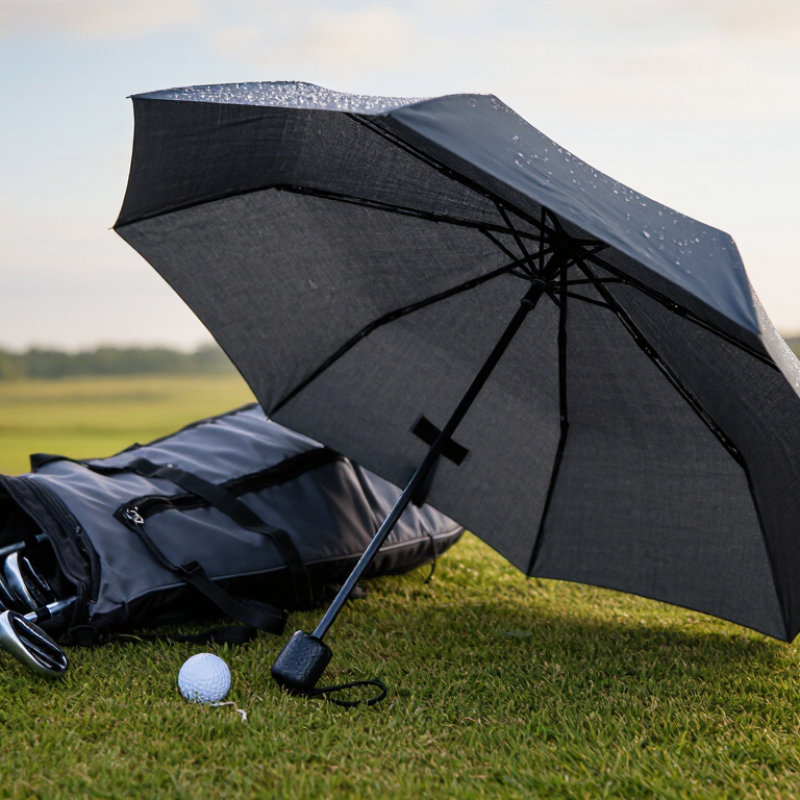
7 Tips for Choosing the Best Foldable Golf Umbrella

Define Golf Umbrella Coverage: Compare Common 60–68-Inch Canopy Spans

A 60-inch golf umbrella is often wide enough to shelter one golfer and a bag, while a 68-inch canopy gives more room for a second person. If those numbers describe the canopy’s straight-line width, the larger span adds about four inches on each side. Its projected coverage can be roughly 28 percent greater, though curved panels and wind change how much rain stays out. Check how the maker measures the canopy; some listings use arc measurements, which are not directly comparable. A size chart can still mislead.

Think about where you walk and store it. A 68-inch foldable umbrella offers welcome shoulder coverage beside a golf cart, but it can feel awkward on a narrow path or in a crowded clubhouse entrance. More fabric may also catch stronger gusts, so inspect the frame, ribs, and venting rather than choosing by span alone. Small details matter. Picture opening it beside your bag: does the canopy clear the clubs, and can you carry it without blocking someone behind you? I would not assume the widest option is automatically best; the extra reach is useful, but its weight and packed length deserve a real check.

Check Folded Length and Weight Against Golf-Bag Storage Needs

A folded golf umbrella can look compact on a product page but still stick out of your golf bag. Measure its full length from the canopy tip to the end of the handle, with the storage sleeve on. Compare that number with the usable depth of your bag’s umbrella pocket or side sleeve. A few centimeters can decide whether it slides in neatly or catches on the zipper.

Check the width, too. Some folded models have bulky handles or stiff covers that make narrow pockets awkward to use. If possible, try the umbrella in your packed bag, not an empty one. Clubs and towels can crowd the space. Small details matter. A paper measurement may not show how easily the umbrella can be pulled out while you are standing beside a cart.

Weight affects comfort over a full round, especially if you carry your bag. Compare the listed weight with the umbrella and sleeve together; removable straps or covers may add more than expected. A lighter option can feel easier on your shoulder, but it may come with a smaller canopy or less substantial frame. There is no perfect number. I would check the balance in your actual bag, since even a modest weight difference can feel noticeable after several holes.

Evaluate Rain Protection Using ISO 811 Hydrostatic-Pressure Testing

When comparing foldable golf umbrellas, do not rely on “waterproof” printed on a hangtag. Ask whether the canopy fabric was tested under ISO 811:2018, the international method for measuring resistance to water penetration under hydrostatic pressure. The result is a pressure value, commonly reported in centimetres of water or kilopascals; 1 kPa is about 10.2 cm of water column. Higher pressure before leakage indicates stronger fabric resistance in this controlled test. That is useful evidence, not a complete umbrella score.

Check the report details. Which side of the fabric faced the water? How many samples were tested? Was the result recorded for the canopy cloth alone, or did testing include stitched panels? Small needle holes and seams can be the weak points, even when the fabric performs well. Ask for the actual figure and test conditions, rather than accepting an unexplained “passed” claim. Not the whole story. ISO 811 evaluates fabric, not protection during gusty, wind-driven rain or after repeated folding. A practical choice pairs documented hydrostatic-pressure results with sturdy seams, secure canopy tension, and a frame that opens smoothly. I would still inspect the stitching closely; a high test number cannot repair a poor seam.

Verify UV Claims Through AATCC 183 Fabric-Transmittance Testing

A dark canopy may look protective, but color alone cannot verify its UV performance. Ask whether the canopy fabric was tested using AATCC 183, a method that measures ultraviolet radiation transmitted through fabric. A reliable report should identify the tested material and provide results, such as UV transmittance or an associated UPF rating. Check that the sample matches the umbrella’s actual canopy, not just a similar fabric swatch. Small detail, big difference.

The test evaluates fabric, not the whole umbrella in use. A narrow canopy, exposed edges, or sunlight arriving at an angle can leave skin uncovered. Hold the umbrella over a chair and notice how much light slips around its sides. That simple check won’t replace lab data, though it helps put the number in context. If you often use the umbrella in rain, ask whether the report describes dry fabric only; moisture and fabric tension may affect real-world performance. I once would have trusted a confident label. I’d now want to see the test details, too. A vague claim proves very little.

Compare Wind-Resistance Evidence, Frame Materials, and Warranty Terms

A wind-resistance claim is useful only when you can see how it was tested. Look for published test conditions, such as wind speed, gust duration, and whether the umbrella was open or shaken. A dramatic number without a method tells you little. Check whether the maker describes results from an independent test or its own trial. Neither guarantees calm days, but clear evidence makes comparisons fairer. In a shop, open and close the umbrella, then gently flex the canopy and shaft. Don’t force it. A few seconds can reveal a sticky runner or loose joints.

Frame material affects weight, flexibility, and upkeep. Fiberglass ribs can bend under pressure and resist rust, while steel may feel sturdy but add weight. Aluminum is often lighter, though construction quality matters more than the label alone. Check the joints, not just the rib material. That matters. For a compact umbrella, a slightly heavier frame may be a reasonable trade if the hinges feel secure.

Read warranty terms before buying. Note the coverage period, what counts as a frame failure, and whether wear, wind damage, or lost parts are excluded. Keep the receipt and product details. I would not treat a long warranty as proof of durability; exclusions can change its value. Policies can be awkward to interpret, so ask for unclear terms in writing.

7 Tips for Choosing the Best Foldable Golf Umbrella — Compare Wind-Resistance Evidence, Frame Materials, and Warranty Terms

Tip What to compare Useful evidence or details How to assess it
1. Look for verifiable wind-resistance evidence A wind rating, test method, or clearly described test conditions. A useful report identifies wind speed, test setup, duration, and what counted as failure. “Windproof” by itself does not state a measurable performance level. Prefer documented testing over an unsupported claim. Treat any stated wind speed as specific to the reported test—not a guarantee for every gust or direction.
2. Compare frame and rib materials The shaft, ribs, joints, and their material descriptions. Fiberglass ribs are generally flexible and corrosion-resistant; steel can be strong but may corrode if its finish is damaged; aluminum is lightweight but strength depends on its design and construction. Check material specifications for each component rather than relying on a broad “reinforced frame” label. Inspect joints and rib connections, which are common stress points.
3. Check canopy coverage and dimensions The stated canopy measurement, open diameter, and packed length. Umbrella measurements may refer to the arc across the canopy or the straight-line diameter; these are not the same. A larger canopy offers more coverage but can be harder to manage in wind. Confirm which measurement is provided and compare it with the product’s open and folded dimensions. Consider whether it fits your golf bag and travel needs.
4. Evaluate the vented canopy design Whether the canopy has vents and how they are constructed. Vented designs allow some air to pass through the canopy, which can reduce pressure buildup. A vent does not make an umbrella immune to inversion or damage in strong gusts. Look for clear photos or a description of the vent layout, and check whether the canopy remains securely attached around the vent openings.
5. Inspect fabric and water-shedding details Canopy fabric, seams, stitching, and any stated water-repellent finish. A water-repellent finish helps water bead and run off, but performance can decline with use. Fabric labels alone do not establish a specific waterproof rating. Check for consistent stitching and reinforced attachment points. Look for care instructions and evidence supporting any waterproof or water-resistance claim.
6. Test the folding mechanism and handle Opening and closing method, locking action, grip, and folded size. Automatic opening or closing can be convenient, but the mechanism adds moving parts. A secure lock and comfortable, nonslip grip matter when handling the umbrella outdoors. Check whether the opening instructions are clear and whether the umbrella locks fully open. Compare the folded length with your bag’s storage compartment.
7. Read the warranty terms before buying Coverage period, eligible defects, exclusions, claim process, and proof-of-purchase requirements. Warranty coverage varies by seller and product. Many warranties distinguish manufacturing defects from accidental damage, ordinary wear, misuse, or wind-related damage. Read the written terms, including repair or replacement conditions, shipping costs, and any registration deadline. Do not assume wind damage is covered unless the terms say so.

Note: Performance depends on design, condition, and weather. Follow the manufacturer’s instructions and close the umbrella when conditions become unsafe.