Menu
Monday
9:00-5:00
Tuesday
9:00-5:00
Wednesday
9:00-5:00
Thursday
9:00-5:00
Friday
9:00-5:00
Saturday
9:00-4:00
Sunday
CLOSED
Backyard swing sets turn a patch of lawn into a place for daily movement, shared play, and small, memorable challenges. For buyers, the hard part is comparing frames, swing seats, finishes, assembly requirements, and after-sales support—not just attractive catalog photos. This guide introduces 10 manufacturers in China and offers a practical starting point for evaluating their products and capabilities.
The figures provide useful context, but they need careful interpretation. Grand View Research estimated the global playground equipment market at USD 6.4 billion in 2023 and projected a 7.5% compound annual growth rate from 2024 to 2030. That category is broader than residential swing sets, so the estimate should not be read as a backyard-swing sales forecast. Play researcher and psychiatrist Dr. Stuart Brown wrote, “The opposite of play is not work; it’s depression.” His observation speaks to play’s wider value, though it does not certify any particular product.
For a closer look, compare manufacturers on details families can inspect: steel or timber construction, weld quality, exposed edges, coatings, anchoring instructions, and replacement-part availability. Ask for current test documents and confirm what each document covers. A supplier’s stated capacity is not the same as independent verification. Details matter. This overview is designed to help readers ask better questions; product suitability still depends on the yard, installation, and the children who will use the set.
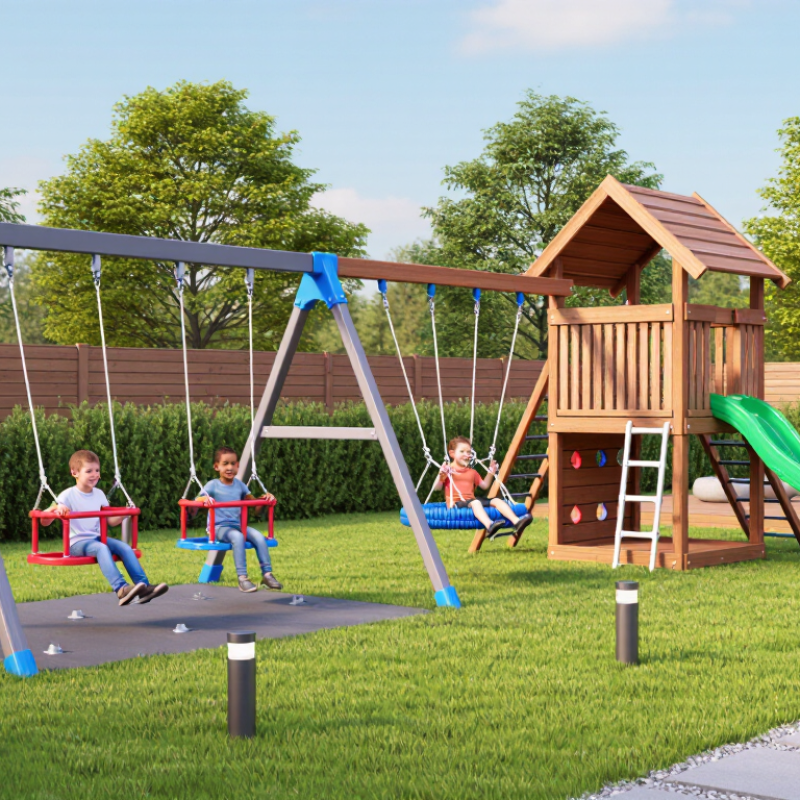
China’s backyard swing set industry is built from linked suppliers, specialist workshops, and final assemblers. Steel tube producers may supply frame sections, while other facilities handle welding, drilling, and protective coating. Seats, ropes, connectors, and bolts can come from separate vendors. Some manufacturers manage several processes themselves; others coordinate subcontractors. That difference can affect production schedules and consistency.
Many factories serve overseas buyers through custom designs or existing product platforms. Their work may include adjusting frame dimensions, selecting materials, preparing assembly instructions, and arranging product inspections. Ask how welds, coatings, and moving joints are checked, and whether the sample matches the production specification. A polished sample is useful, but it does not prove every shipment will be identical. Supply chains can shift, and even experienced teams sometimes miss small changes. That deserves honest follow-up.
Tips: Request a parts list, material details, and clear inspection records. Compare these with the actual sample. Check packaging too; a bent tube or missing bolt can turn a sound design into a frustrating assembly.
A schematic view of common activities across the manufacturing value chain, from product planning to export preparation.
Values count the example activities listed for each stage; they are not company counts, market shares, or production statistics. Processes vary by factory and product.
Selecting a backyard swing set manufacturer requires more than comparing prices or product photos. Start with materials and construction details. Ask whether frames use weather-resistant steel or treated timber, and how joints, fasteners, and coatings withstand repeated outdoor exposure. A reliable supplier should explain these choices clearly, not rely on vague claims. Look for practical details, such as rounded edges, stable anchoring points, and smooth finishes where children may grip or climb.
Safety documentation matters. Request test reports, inspection procedures, and clear age and weight guidance for each design. Check whether production samples are reviewed consistently, since a well-built sample does not guarantee every unit matches it. Ask how the manufacturer handles defects and replacement parts. Small hardware can disappear during shipping. It happens. Clear records and responsive quality teams help resolve issues before installation becomes a headache.
Evaluate production capacity, customization, and communication together. A factory may offer attractive options, but changes to colors or layouts can affect lead times and consistency. Ask for a realistic schedule, packaging specifications, and photos of completed production—not only polished catalog images. References from comparable projects can add useful context, though they are not a substitute for direct checks. No checklist catches every problem. A careful buyer should still compare documents, samples, and answers before choosing a manufacturing partner.
A practical, brand-neutral scorecard for evaluating manufacturers. The ranking below orders selection criteria by suggested importance; it does not rank or identify individual companies.
| Rank | Selection criterion | Suggested weight | What to evaluate | How to verify |
|---|---|---|---|---|
| 1 | Product safety and design | 20% | Structural stability, load limits, pinch and entrapment risks, fall zones, age guidance, and clear assembly and use instructions. | Review product-specific risk assessments, drawings, warnings, and test reports. Confirm that any cited standard is relevant to the product and destination market; examples may include ASTM F1148 for home playground equipment in the United States. |
| 2 | Material quality and durability | 15% | Frame material and coating, timber treatment where applicable, UV and weather resistance, corrosion protection, and the quality of ropes, seats, fasteners, and connectors. | Request material specifications, coating details, supplier documentation, and evidence of corrosion or weathering tests. Check whether claims apply to the finished product, not just an individual component. |
| 3 | Quality-control system | 13% | Incoming-material checks, in-process inspections, final inspection, defect handling, batch traceability, and procedures for corrective action. | Review documented inspection plans and sample records. Ask how production lots are identified and how nonconforming products are isolated and corrected. |
| 4 | Testing and compliance capability | 12% | Ability to arrange applicable mechanical, chemical, or other product testing and to maintain technical files for the intended sales markets. | Check the report's product model, tested configuration, date, and issuing laboratory. Verify the laboratory's accreditation and the test's scope where relevant; do not treat a general certificate as proof that every product complies. |
| 5 | Manufacturing capacity and process control | 10% | Relevant production equipment, skilled staff, realistic capacity, stable production processes, and the ability to handle seasonal demand without reducing inspection quality. | Use a factory audit or live production review. Compare stated capacity with equipment, staffing, work-in-progress, and recent production schedules. |
| 6 | Export packaging and logistics readiness | 8% | Flat-pack design, protection against transit damage, carton labeling, shipping dimensions, packing lists, and experience coordinating export documentation. | Inspect a packed sample and shipping marks. Confirm carton measurements, packing details, and document responsibilities before placing an order. |
| 7 | Customization and engineering support | 7% | Capacity to adapt dimensions, colors, accessories, packaging, and instructions while maintaining design control and safety review. | Request approved drawings and a pre-production sample. Confirm how design revisions are recorded and whether changes trigger renewed testing or risk assessment. |
| 8 | Supply-chain traceability | 5% | Documented sourcing for key materials and components, reliable supplier management, and traceability from incoming materials to finished goods. | Ask for material and component records, lot identification practices, and the process for managing supplier or material changes. |
| 9 | After-sales service and spare parts | 5% | Availability of replacement components, warranty terms, response procedures, and support for assembly or product-safety questions. | Review written warranty and service terms. Ask for a spare-parts list, expected availability period, and a sample process for resolving a reported defect. |
| 10 | Commercial transparency and delivery reliability | 5% | Clear quotations, defined specifications, realistic lead times, payment terms, and documented responsibility for changes and delays. | Compare the quotation, approved specification, purchase order, and sample. Check delivery performance using references or shipment records where available. |
Scoring note: The percentages are suggested buyer-assessment weights, not industry statistics or a published ranking. Score each prospective manufacturer against the same evidence and product specification; confirm all safety and regulatory requirements for the destination market before sale.
The ten profiles reflect different capabilities found among Chinese backyard swing set manufacturers, rather than verified rankings. One factory may specialize in steel frames, with welded joints and powder-coated finishes. Another may focus on timber structures, where smooth edges and weather-resistant treatment matter. A third may offer compact sets for smaller gardens. Some manufacturers combine swings with slides or climbing frames. Others concentrate on simpler, modular designs that are easier to pack and assemble.
Several workshops may provide custom colors, dimensions, or packaging, while larger production sites may emphasize repeatable output. One supplier might have stronger experience with export documentation; another may offer more detailed assembly guides. Look for clear material specifications, load-test records, inspection procedures, and replacement-part support. Ask for photographs of finished products and packaging, not only polished renderings. Details matter. A coating can look even in a photo yet wear quickly outdoors. Supplier profiles are useful starting points, but public information can be incomplete or outdated. Verify each manufacturer’s facilities, product samples, and quality records before making a decision.
Backyard swing sets differ in play style, footprint, and upkeep. Single-seat swings suit compact yards, while multi-activity frames may combine swings, climbing bars, and slides. Timber feels substantial and can be repaired, but needs checks for splinters, rot, and loose bolts. Galvanized steel is usually lower-maintenance, though scratched coatings can expose rust. Molded plastic seats stay light and easy to clean. Small details matter: a smooth seat edge and covered fasteners reduce snag and impact hazards.
Safety deserves more weight than accessory count. The U.S. Consumer Product Safety Commission’s Public Playground Safety Handbook reports that falls cause about 79% of playground injuries; this figure concerns playground equipment broadly, not backyard sets alone. ASTM F1148 provides a home-playground equipment safety standard, so buyers can check whether a product is designed against its requirements. Look for stable anchoring, guarded openings, secure joints, and a clear fall zone over suitable impact-absorbing surfacing. Measure the yard before ordering. A set can look sturdy in a catalog and still wobble on uneven ground. I would also inspect ropes, chains, and anchors regularly; installation quality is easy to underestimate.
For China-based backyard swing set suppliers, verify the factory behind the quotation, not just its product catalog. The World Bank’s World Development Indicators show China generated about 31% of global manufacturing value added in 2022. That scale is useful, but it says little about one factory’s workmanship or available capacity.
Request a current ISO 9001 certificate and confirm its scope, issuing body, and validity. The ISO Survey 2022 reported roughly 1.27 million ISO 9001 certificates worldwide; certification indicates a quality-management system, not proof that a swing set is safe. Ask for test reports tied to the exact model, materials, and target market. Check welds, coated steel, timber treatment, fasteners, and pinch-point safeguards. Paper is not proof.
Capacity needs evidence, too. Compare monthly output with recent purchase orders, staffing, shift patterns, and equipment lists. Ask suppliers to show how they control load testing and final inspections, then review dated production records. A factory tour can still be staged; treat it as one clue, not a verdict. One weak point in this assessment is seasonality: a quiet visit may not reveal peak-season bottlenecks. Request a sample schedule and confirm lead times in writing.