Menu
Monday
9:00-5:00
Tuesday
9:00-5:00
Wednesday
9:00-5:00
Thursday
9:00-5:00
Friday
9:00-5:00
Saturday
9:00-4:00
Sunday
CLOSED
China has become a major sourcing hub for Cold Plunge Tub systems, serving gyms, hotels, wellness clinics, and private buyers worldwide. Yet factory quantity does not guarantee dependable quality. This guide examines manufacturers through practical purchasing criteria, including insulation, stainless-steel grades, refrigeration capacity, filtration design, electrical safety, and after-sales support.
Dr. Susanna Søberg, a leading cold-exposure researcher, describes cold exposure as “a hormetic stressor.” This perspective matters. A Cold Plunge Tub should support controlled use, not encourage careless endurance challenges. Reliable manufacturers provide clear temperature ranges, stable controls, drainage solutions, and user-safety guidance. Buyers should also verify testing records, production experience, customization ability, and compliance documentation for the destination market.
The strongest Chinese suppliers usually show their work. They share factory images, component specifications, sample-testing procedures, and realistic lead times. Some offer attractive prices, but their warranty terms remain vague. That is a warning sign. Others produce excellent tubs yet communicate poorly with overseas customers. This can create expensive misunderstandings about voltage, installation, packaging, or replacement parts.
This article compares China’s leading Cold Plunge Tub manufacturers from a global buyer’s perspective. It considers product quality, engineering capability, export experience, customization, and service reliability. No ranking can replace independent inspection. That limitation deserves attention. A supplier may appear impressive online and still require careful verification before payment. Practical evidence matters more than polished claims.
China’s cold plunge tub manufacturing landscape is broad, export-focused, and increasingly technical. Factories commonly combine insulated shells, refrigeration units, circulation pumps, ozone systems, and replaceable filters. Manufacturing depth matters. China’s National Bureau of Statistics reported manufacturing value added of about RMB 33.5 trillion in 2023. This supports strong supply-chain access for stainless steel, acrylic, electronics, and thermal insulation.
Demand is also linked to wider wellness spending. The Global Wellness Institute’s 2024 Global Wellness Economy Monitor valued the global wellness economy at USD 6.3 trillion in 2023. However, this figure does not measure cold plunge tubs alone. Market forecasts differ widely because the category overlaps with spas, ice baths, recovery equipment, and home fitness. Buyers should treat headline estimates carefully.
The strongest Chinese suppliers usually offer OEM engineering, sample testing, and documented quality controls. Ask for water-temperature stability data, electrical safety reports, leakage tests, and compressor performance under continuous operation. Check insulation thickness, drainage design, filter access, and noise levels. Small details matter.
Factory audits remain useful.
So does third-party testing.
A practical concern is after-sales support. Replacement pumps, sensors, and filters need clear part numbers and realistic delivery times. Some catalogs look impressive but reveal little about long-term reliability. That weakness deserves attention. A factory video cannot replace a production inspection, signed specifications, and a documented pre-shipment test.
China’s leading cold plunge tub manufacturers serve three practical segments: portable inflatable tubs, insulated non-chiller tubs, and active cooling systems.
Portable models suit home users and small studios. Chiller systems provide steadier temperatures for gyms, hotels, and recovery centers. The Global Wellness Institute reported a $6.3 trillion wellness economy in 2023, with growth projected toward $9 trillion by 2028. Cold-water recovery is benefiting from this wider investment, although market studies still disagree on its exact size.
For global buyers, key features include:
stainless-steel or reinforced composite shells, insulated covers, adjustable water temperatures, filtration, ozone or UV sanitation, and quiet pumps.
A reliable unit should also show flow rates, cooling capacity, power requirements, drainage design, and replacement-part availability. Electrical protection matters in wet environments. Ask for test reports covering electrical safety, electromagnetic compatibility, refrigerants, and water-contact materials.
A polished brochure is not proof of performance. I would request a video test, serialised inspection records, and a sample before placing a large order.
Tips:
Compare recovery time, not only the lowest temperature. Confirm voltage, plug type, warranty terms, and customs documents. The International Spa Association highlights maintenance as a major operating cost. That warning deserves attention. Some buyers overlook cleaning access and later regret it. Use a written inspection checklist, and verify every claimed certification with the issuing body.
Evaluating Chinese cold plunge tub manufacturers requires more than comparing factory prices. The Global Wellness Institute reported that the wellness economy reached $6.3 trillion in 2023. McKinsey estimated the broader consumer wellness market at $1.8 trillion annually in 2024. These figures show strong demand, but they do not prove a supplier’s reliability. Ask for factory ownership details, production capacity, quality certificates, and recent export references. A video tour helps, but an independent factory audit is stronger evidence.
Inspect the tub in person or request a documented sample. Check insulation thickness, stainless-steel grade, weld quality, drainage, filtration, and temperature stability. Ask for test records covering electrical safety, leakage, noise, and continuous operation. ISO 9001 certification can indicate process control, yet certification alone cannot confirm product quality. Request batch records and a written corrective-action process. Small details matter.
Do not trust attractive catalog images.
A manufacturer should explain its cooling capacity under different ambient temperatures. Compare test conditions carefully, because “reaches 3°C” means little without water volume and room temperature. Confirm spare-part availability, packaging tests, warranty limits, and response times. A pre-shipment inspection can reduce surprises, although it cannot replace long-term field data. I would also order a pilot batch before scaling. That step costs more initially, but it may expose weak pumps, unclear manuals, or inconsistent finishing that a factory presentation hides.
China’s cold plunge tub manufacturers serve a growing wellness market. The Global Wellness Institute valued the global wellness economy at $5.6 trillion in 2022. It projects $8.5 trillion by 2027. Demand is rising, but purchasing decisions require more than attractive product photos.
Quality begins with controlled production. ISO 9001 certification can show documented processes, corrective actions, and traceability. The ISO Survey 2023 recorded over 1.2 million ISO 9001 certificates worldwide. However, certification alone does not prove tub safety. Buyers should request electrical test reports, leakage-current results, grounding checks, and material declarations. CE marking may apply to products entering the European Economic Area. RoHS and REACH evidence may also be necessary. UKCA, FCC, or local approvals depend on the destination. Requirements can change. That part deserves careful review.
Tips: Ask for the complete technical file, not only a certificate image. Check whether the certificate names the actual factory. Confirm test standards, report dates, model numbers, and laboratory accreditation. Inspect welds, insulation, drainage, filtration, and emergency shutoff details. Export documents should match the commercial invoice and packing list. Small mismatches can delay customs clearance. In my experience, suppliers sometimes provide excellent samples but weaker batch consistency. A pre-shipment inspection is therefore sensible. Mistakes still happen. Good compliance planning reduces their cost.
| Evaluation Dimension | Applicable Standard or Requirement | What Global Buyers Should Check | Typical Evidence | Primary Market Relevance | Compliance Status | Buyer Note |
|---|---|---|---|---|---|---|
| Product Safety | General product-risk assessment, safe edges, stable construction, and appropriate user instructions. | Inspect the tub body, steps, covers, drain fittings, access points, and warning labels for foreseeable use and misuse risks. | Risk-assessment report, product drawings, inspection records, and user manual. | All export markets | Required | Requirements vary by product configuration and destination. |
| Electrical Safety | IEC 60335-1 principles may be relevant to household electrical appliances; local adoption must be confirmed. | Verify protection against electric shock, grounding, insulation, water ingress, abnormal operation, and overheating. | Electrical safety test report, wiring diagram, component specifications, and routine test records. | Global markets with powered chillers or pumps | Required where powered | A standard reference does not replace destination-country approval. |
| Ingress Protection | IEC 60529 IP ratings, when an IP claim is made for an electrical enclosure. | Confirm that the tested enclosure, seals, cable entries, and operating configuration match the shipped product. | IP test report issued for the relevant model or enclosure. | Markets requiring water and dust protection claims | Model-specific | Do not accept an IP rating without a matching test scope. |
| Electromagnetic Compatibility | Applicable EMC requirements, such as the EU EMC Directive for qualifying products placed on the EU market. | Check emissions and immunity performance for chillers, control boards, pumps, Wi-Fi modules, and other electronic assemblies. | EMC test report, technical file, declaration of conformity, and product identification. | European Union and other regulated markets | Market-dependent | Radio-enabled products may require additional radio compliance. |
| CE Documentation | CE marking may apply to products covered by relevant EU legislation, including electrical, EMC, RoHS, or radio rules. | Confirm the applicable directives or regulations, harmonized standards used, responsible economic operator, and technical documentation. | EU Declaration of Conformity, technical file, test reports, and CE marking artwork. | European Union and EEA markets | Conditional | CE is a conformity declaration, not a universal quality certification. |
| RoHS Compliance | EU RoHS restrictions on certain hazardous substances in electrical and electronic equipment, where applicable. | Review materials used in circuit boards, cables, solder, connectors, motors, switches, and electronic controls. | Material declarations, supplier declarations, and laboratory screening or test reports. | European Union and markets referencing RoHS | Required where applicable | Confirm whether the complete product falls within the applicable product scope. |
| Materials and Chemical Safety | REACH obligations may apply to articles and substances supplied into the European Union. | Identify plastics, elastomers, coatings, adhesives, refrigerants, and other substances that may trigger disclosure or restriction duties. | REACH declaration, substance disclosure, safety data sheet, and supplier material records. | European Union | Market-dependent | Chemical obligations depend on composition, quantity, and intended use. |
| Water Contact Materials | Destination-specific requirements may apply when water-contact materials are regulated. | Verify the composition and migration performance of liners, seals, hoses, fittings, and coatings used in contact with bathing water. | Material specifications, migration testing, and supplier declarations. | EU, UK, North America, and other regulated markets | Destination-specific | Requirements differ between recreational, domestic, and drinking-water applications. |
| Temperature Performance | Performance claims should be supported by a defined test method and operating condition. | Compare cooling range, pull-down time, temperature stability, ambient conditions, water volume, and filtration status. | Performance test report, calibrated thermometer records, and operating-condition statement. | All markets | Required for claims | Cooling results are strongly affected by ambient temperature and insulation. |
| Leak and Pressure Testing | Factory leak testing for the tub, plumbing circuit, heat exchanger, pump, and drain assembly. | Confirm test pressure or test duration, inspection points, acceptance criteria, and corrective-action records. | Factory inspection checklist, pressure-test records, and final inspection report. | All markets | Required | Testing should cover both the tub and connected water-circulation equipment. |
| Quality Management | ISO 9001 is a voluntary quality-management-system certification, not a product certification. | Check certificate scope, issuing certification body, validity, manufacturing site, document control, and corrective-action process. | Valid ISO 9001 certificate and audit or surveillance information. | Global sourcing programs | Recommended | Verify the certificate independently with the certification body where possible. |
| Factory Inspection | Independent pre-production, during-production, or pre-shipment inspection based on an agreed inspection plan. | Define sampling level, critical defects, major defects, minor defects, functional tests, packaging checks, and photo requirements. | Third-party inspection report and signed inspection checklist. | All international shipments | Recommended | Inspection is most effective when acceptance criteria are agreed before production. |
| Factory Acceptance Testing | Buyer-approved functional testing before shipment. | Test start-up, cooling, circulation, filtration, controls, alarms, drainage, noise, and power consumption against the purchase specification. | FAT protocol, test data, serial-number traceability, and signed release record. | Commercial and private-label projects | Recommended | Use the same model configuration and firmware intended for shipment. |
| Packaging and Transit Protection | Export packaging suitable for the selected transport mode and handling environment. | Check moisture protection, cushioning, edge protection, carton strength, palletization, lifting marks, and accessory separation. | Packaging specification, drop or vibration test record, packing list, and shipping photos. | Sea, air, rail, and multimodal freight | Required | Wood packaging may require ISPM 15 treatment and marking. |
| Export Classification | Correct HS classification and customs description for the tub, chiller, pump, accessories, and spare parts. | Confirm whether components ship as one system or separate line items and whether the importer has local classification requirements. | Commercial invoice, packing list, HS code proposal, and product description. | All importing countries | Required | Final classification is determined by the relevant customs authority. |
| Shipping Documents | Standard export documentation matched to the sales contract and transport method. | Verify consistency of consignee, country of origin, quantities, weights, model numbers, and declared values across documents. | Commercial invoice, packing list, bill of lading or airway bill, certificate of origin, and insurance document where required. | All international shipments | Required | Document requirements vary by destination, Incoterms, and importer status. |
| User Information | Clear installation, operation, maintenance, electrical, water-treatment, and safety instructions in the destination language. | Check electrical ratings, grounding instructions, minimum clearances, drainage, cleaning, filter replacement, and emergency procedures. | Manual, quick-start guide, warning labels, wiring instructions, and maintenance schedule. | All markets | Required | Translation and language rules should be confirmed before mass production. |
| Warranty and After-Sales Support | Written warranty terms and a defined process for spare parts, technical support, and product claims. | Review warranty duration, exclusions, response times, replacement policy, remote diagnostics, and availability of consumables. | Warranty statement, service procedure, spare-parts list, and escalation contacts. | All global buyers | Commercial requirement | Warranty coverage should be aligned with the destination market and installation conditions. |
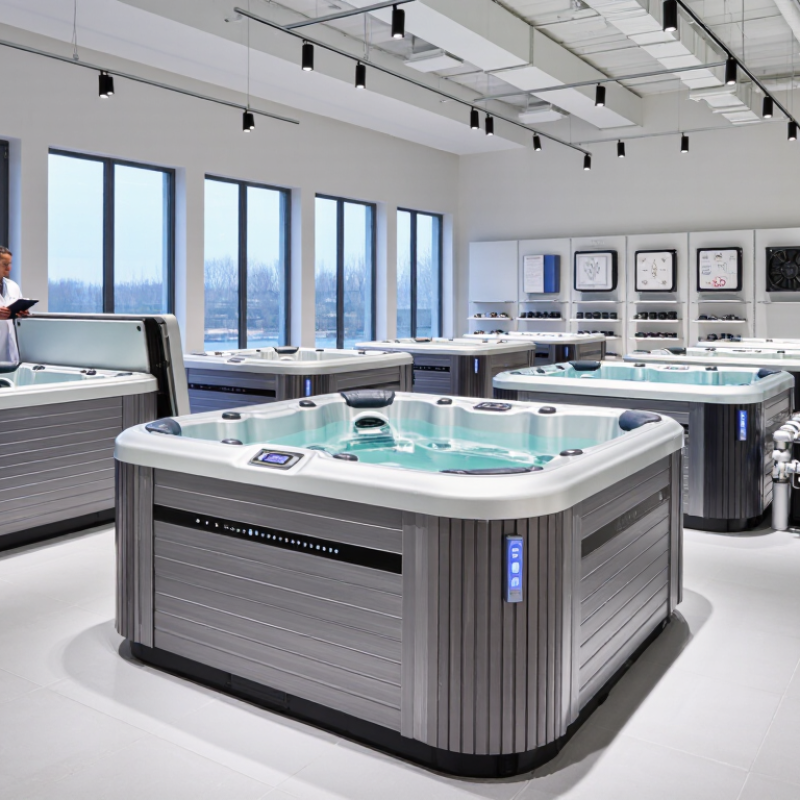
Sourcing cold plunge tubs from China requires more than comparing online prices. Experienced buyers should check factory capacity, export history, production photos, and quality records. Request material specifications for the tub shell, insulation, chiller, pump, and filtration system. A live video inspection can reveal details that catalog images hide, including weld quality and drainage design. Ask for a sample before placing a larger order.
Pricing depends on dimensions, water temperature range, cooling power, control systems, packaging, and order volume. A small insulated tub may cost less, but shipping can change the final figure. Confirm the quotation in writing, including tooling, spare parts, packaging, payment terms, and delivery conditions. Low prices can be misleading. Some buyers overlook electrical compatibility or replacement costs.
Customization may include color, logo placement, drain position, insulation thickness, and control-panel language. Keep technical drawings simple and approve a pre-production sample. After-sales support should cover installation guides, troubleshooting videos, spare-part availability, and response times. Clarify who handles damaged goods during transit and how warranty claims are documented. A reliable supplier should provide serial-number tracking and clear maintenance instructions. Support is often promised broadly, yet response quality can weaken after payment. Build this risk into the contract. Test every unit on arrival, record water temperature, inspect fittings, and keep photographs for future claims. Mistakes happen. Good systems make them manageable.
Indicative China FOB price ranges for common cold plunge tub configurations. Actual quotations vary according to capacity, insulation, cooling performance, materials, certifications, packaging, order volume, and customization requirements. Buyers should confirm specifications, production lead times, warranty coverage, spare parts, and after-sales support before placing an order.