• Monday

    9:00-5:00

  • Tuesday

    9:00-5:00

  • Wednesday

    9:00-5:00

  • Thursday

    9:00-5:00

  • Friday

    9:00-5:00

  • Saturday

    9:00-4:00

  • Sunday

    CLOSED

Top Mesh Playpen for Babies What Should Global Buyers Know?

Choosing the top Mesh Playpen requires more than comparing prices, colors, and product photographs. Global buyers must examine safety design, material quality, supplier reliability, and real household use. A playpen may look spacious online, yet feel narrow beside a sofa or changing table. Small details matter. Check the mesh strength, frame stability, corner padding, locking system, floor support, and zipper performance. Babies explore with their hands, mouths, and knees.

Experienced buyers should request samples before placing large orders. Inspect stitching closely. Pull the mesh gently. Open and close every lock several times. Confirm the recommended age, height, weight, and assembly method. Independent laboratory reports can support quality claims, but buyers should verify their scope, date, and issuing organization. Requirements may differ between countries, so suppliers must provide accurate documentation for the intended market. Avoid relying on vague statements such as “international standard.”

A responsible Mesh Playpen should support supervised play, not replace adult attention. It should also be used for sleep only when the manufacturer clearly permits it. Ventilation, cleanable fabrics, odor control, and compact storage can influence customer satisfaction. Packaging deserves attention too. Broken panels or missing instructions create avoidable returns. Still, no playpen is perfect. I have seen attractive products lose value because their wheels resisted locking or their instructions confused new parents. That weakness deserves honest review. Global buyers should balance test results, user feedback, factory communication, and after-sales support before choosing a product for families.

Top Mesh Playpen for Babies What Should Global Buyers Know?

What Is a Mesh Playpen and Why Do Babies Need One?

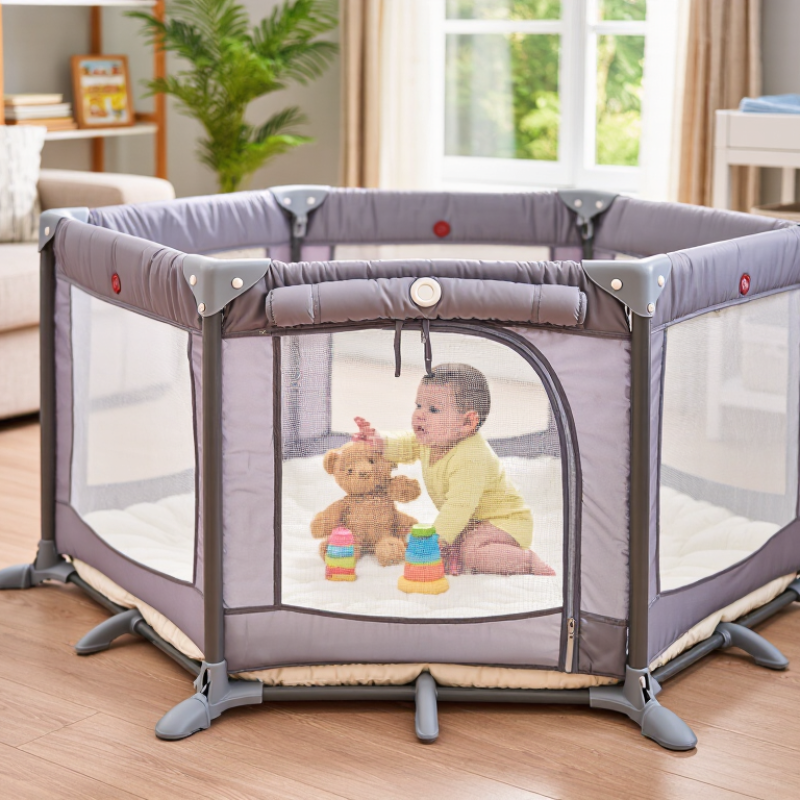
A mesh playpen is a lightweight, enclosed area with breathable fabric panels and a stable frame. It gives babies a defined space for crawling, sitting, and supervised floor play. The mesh sides improve airflow and allow caregivers to see the child from nearby rooms. A quality model should have secure seams, smooth edges, strong locks, and a firm, level base.

Babies need boundaries because mobility develops quickly. A crawling baby can reach electrical cords, pet bowls, small objects, or unstable furniture within seconds. A playpen can reduce these everyday hazards while giving caregivers time to prepare food or answer a call. It is not a babysitter. Supervision remains essential. Never add pillows, loose blankets, toys with long cords, or heavy objects that could create climbing risks.

Global buyers should check the product’s recommended age, height, and weight limits before ordering. Safety requirements differ between countries, so buyers should review local standards and clear assembly instructions. Inspect the frame after delivery. Small details matter. In practical use, a playpen may seem spacious until a baby starts pulling up. That common assumption deserves reconsideration. Keep the pen away from windows, heaters, stairs, and furniture. A mesh playpen supports safer play, but it cannot replace attentive care or a properly prepared room.

Key Safety Features to Check Before Buying a Baby Playpen

Choosing a mesh playpen requires more than checking its size or appearance. Global buyers should inspect the frame, mesh, base, and locking system carefully. A stable frame should resist tipping when gently pushed from several sides. The locking mechanism must stay secure during repeated opening and closing. Avoid designs with sharp edges, loose cords, or openings that could trap small fingers.

The mesh should feel firmly attached and allow clear airflow and visibility. Check every seam for gaps, rough stitching, or weak corners. The floor should remain flat without folding into hazardous ridges. Materials should have clear care instructions and reliable product information. Safety expectations differ between markets, so buyers should review applicable local standards and request test documents from suppliers. I have learned not to trust appearance alone. A polished finish can still hide poor stitching.

Tips: Ask for close-up photos and assembly videos before ordering. Test the lock repeatedly. Measure the folded package, not only the open playpen. Check whether replacement parts are available. Keep the playpen away from heaters, windows, stairs, and dangling cords. Adult supervision remains necessary, even when the playpen looks secure. Some buyers overlook cleaning access, but spills can collect inside narrow seams. This detail matters more than expected.

How to Choose the Right Size, Structure, and Materials

Top Mesh Playpen for Babies: What Should Global Buyers Know?

Choosing the right size starts with the baby’s daily movement. Measure the available floor area, then leave space for crawling, standing, and supervised play. A compact pen may suit a small apartment, but it can become restrictive quickly. Check the internal dimensions, not only the external size. A caregiver should also reach the child without leaning dangerously over the rail. There is no perfect size.

Structure matters more than appearance. Look for a rigid frame, secure locking joints, stable feet, and rails that resist folding during normal use. Mesh panels should stay taut and allow clear visibility from several angles. Avoid wide gaps, loose fabric, exposed fasteners, or sharp edges. Press each corner gently before purchase. It should not wobble easily. A lower entrance may help crawling babies, but it needs a reliable closure.

Material checks require careful attention. Choose breathable mesh, smooth stitching, and padded contact areas without strong chemical odors. Ask suppliers for material specifications, safety test reports, and inspection records relevant to the destination market. Requirements can differ between regions, so old documents may not be enough. Waterproof fabric sounds useful, yet poor coating can reduce airflow. This detail is easy to overlook. Buyers should inspect samples after washing, because shrinkage, fading, or loose seams may appear later. Even experienced purchasers can misjudge durability from photographs alone.

Top Mesh Playpen for Babies: Choosing the Right Size

This chart compares usable floor area calculated from common playpen footprints. Buyers should confirm internal dimensions, mesh strength, frame stability, padding, and applicable safety requirements in the destination market before placing an order.

Floor area is calculated as length × width: 100 × 70 cm = 0.70 m², 120 × 120 cm = 1.44 m², 150 × 150 cm = 2.25 m², and 180 × 180 cm = 3.24 m². Larger footprints provide more room for movement but require stronger joints, a stable base, secure locking points, and sufficient room around the playpen.

Comparing Mesh Playpen Types for Different Family Needs

Choosing a mesh playpen depends on the family’s daily routine, not only room size. A stationary full-height model suits frequent indoor use, especially near a sofa or kitchen. It usually offers stronger frames and more stable panels. A foldable travel model fits smaller homes and frequent trips. However, thinner frames may flex more during repeated folding. Modular play yards provide wider layouts for twins or toddlers, but extra panels create more joints to inspect.

Safety evidence should guide the purchase. The American Academy of Pediatrics reports roughly 3,500 sleep-related infant deaths annually in the United States. A mesh playpen should not replace a dedicated, approved sleep space. Airflow is helpful, but it does not remove suffocation risks. Buyers should check locking mechanisms, fabric tension, mattress fit, and visible gaps. ASTM F406 and EN 12227 offer useful reference standards, although local requirements can differ. CPSC safety guidance also encourages checking recalls and testing labels before use.

Tips: Measure the doorway first. Test every lock with one hand. Avoid loose pillows and hanging toys. Inspect seams after travel. A dark mesh can make supervision harder in dim rooms. This detail is easy to overlook. Families may also prefer washable panels, but removable fabric can become loose after poor washing. Read the care instructions carefully. A lower price is not automatically poor quality, yet unclear testing information deserves caution.

Global Buying Factors: Standards, Shipping, and Supplier Quality

Global buyers choosing a mesh playpen should treat safety standards as a purchasing filter, not a marketing phrase. Ask for current test reports covering frame strength, mesh tear resistance, openings, flammability, and chemical limits. Requirements differ by destination, so a certificate from one market may not satisfy another. Check the report number, laboratory name, test date, and product model. Photos alone prove little. Inspect the mesh seams closely. Pull gently and look for loose threads, sharp fasteners, or uneven stitching. Small faults can appear before larger failures.

Shipping decisions affect safety after production. Confirm packed dimensions, carton protection, moisture barriers, and spare-part arrangements before payment. A playpen can arrive with bent tubes after a long sea journey. Request drop-test evidence for the packed carton, not only the assembled unit. Clarify shipping terms, port responsibilities, inspection timing, and damaged-carton procedures. Air freight is faster, but it may raise landed costs sharply. Sea freight saves money, yet seasonal delays can disrupt launch plans.

Supplier quality deserves direct verification. Review factory experience, material traceability, incoming inspection records, and corrective-action reports. Ask for a sample from normal production, not a specially polished sample. Compare it with the approved specification. One supplier may send a strong prototype, while later samples use thinner tubing. That gap is easy to miss. Independent pre-shipment inspection is sensible, but it cannot replace your own risk assessment. Keep records of revisions, packaging approvals, and batch codes. Test setup with tired hands. Real caregivers rarely assemble products in perfect conditions.

Top Mesh Playpen for Babies What Should Global Buyers Know? - Global Buying Factors: Standards, Shipping, and Supplier Quality

Buying Dimension What Global Buyers Should Check Relevant Standard, Rule, or Practice Evidence to Request Practical Buying Note
Product classification Confirm whether the product is marketed as a playpen, play yard, travel cot, or another category in the destination market. Safety obligations depend on the product’s intended use, construction, age range, and destination country. Product description, intended-use statement, age recommendation, dimensions, and folding configuration. Do not rely on a generic “baby product” classification when determining compliance requirements.
United States compliance Check requirements for play yards sold in the United States, including structural, labeling, registration, and testing obligations. 16 CFR Part 1221 establishes the U.S. safety standard for play yards and incorporates applicable requirements based on ASTM F406. Current third-party test report, children’s product certificate where applicable, tracking-label artwork, and product registration information. A supplier’s general certificate or internal inspection report is not a substitute for destination-market compliance documentation.
European market compliance Verify safety requirements for domestic-use playpens and any additional chemical, labeling, or consumer-product obligations in the destination country. EN 12227 covers safety requirements and test methods for playpens for domestic use. The applicable version should be confirmed before purchase. Test report against the requested EN standard, risk assessment, materials declaration, warnings, and instructions for use. A European test report may not automatically satisfy requirements outside Europe; match the report to the sales market.
Mesh and ventilation Review mesh strength, attachment, openings, visibility, ventilation, and the risk of entrapment or tearing. Requirements are assessed through the applicable product safety standard and destination-market rules rather than by mesh appearance alone. Material specification, seam-strength results, dimensional inspection records, and photographs of all mesh attachment points. A fine-looking mesh is not sufficient evidence of safety; seams, fasteners, and frame connections also require inspection.
Frame and locking system Check stability, folding joints, locking indicators, accidental-collapse resistance, and the durability of the frame. Structural and mechanical requirements are included in applicable play-yard or playpen safety standards. Opening-and-closing cycle records, stability test results, lock-function inspection, and production control procedures. Approve a production sample after repeated folding tests, not only after checking a single showroom sample.
Mattress and padding Confirm that the mattress or padded base fits securely, cannot create hazardous gaps, and is not promoted for an unintended sleep use. Sleep-related claims can trigger additional requirements. The relevant rule depends on the product design and marketing claims. Mattress dimensions, attachment method, firmness or thickness specification, warnings, and approved product photographs. Keep product claims consistent with the tested configuration and the instructions supplied with the product.
Chemical and material safety Assess plastics, coatings, textiles, foam, dyes, adhesives, and metal parts for restricted substances applicable to the destination market. Chemical restrictions vary by jurisdiction. U.S. children’s-product rules and European chemical requirements should be reviewed separately. Material composition, supplier declarations, chemical test reports, and evidence that tested materials match production materials. Request change-control notification before any substitution of fabric, coating, foam, ink, or adhesive.
Labels and instructions Check permanent product identification, manufacturer or importer information, warnings, age guidance, assembly instructions, and care information. Labeling content and language requirements differ by destination country and sales channel. Final artwork, translated instruction manual, warning-label material specification, and traceability code format. Approve labels only after the final product configuration and destination markets are confirmed.
Shipping mode selection Compare ocean freight, air freight, rail, courier, and multimodal options according to order size, urgency, and destination. Actual transit time depends on route, carrier schedule, port congestion, customs clearance, and delivery terms. Freight quotation showing origin, destination, mode, chargeable weight or volume, included services, and exclusions. Request separate estimates for production time, origin handling, transit, customs clearance, and final delivery.
Packaging and container efficiency Measure packed length, width, height, gross weight, carton quantity, pallet pattern, and protection against compression or moisture. Freight charges may be based on actual weight, dimensional weight, or occupied volume depending on the transport mode. Carton specification, packing list, loading plan, drop-test or transport-test records, and packaging photographs. A smaller folded package can reduce logistics cost, but packaging must still protect locking parts and mesh seams.
Incoterms and landed cost Define who pays for export clearance, freight, insurance, import clearance, duties, taxes, and final delivery. Incoterms® 2020 allocate selected costs, responsibilities, and risk between seller and buyer; they do not determine product compliance. Written quotation with named place, Incoterms rule and year, freight inclusions, insurance terms, and customs responsibility. Calculate total landed cost separately from the factory price and confirm whether destination charges are included.
Customs documentation Ensure the commercial invoice, packing list, transport document, origin information, and product description are consistent. HS classification and duty treatment depend on the product’s materials, construction, and importing country; customs authorities make the final determination. Draft commercial invoice, packing list, bill of lading or airway bill details, country-of-origin information, and broker review. Do not select an HS code solely from a supplier quotation; verify it with the customs broker or relevant authority.
Supplier identity and capability Verify legal identity, manufacturing location, production scope, export experience, and whether the supplier is a factory or trading intermediary. Supplier verification is a commercial risk-control activity and does not replace product testing. Business registration information, facility address, production-line photographs or audit, capacity statement, and reference shipment records. The legal entity named on the purchase contract should match the entity responsible for quality and documentation.
Quality management system Review incoming-material controls, production inspection, final inspection, nonconformance handling, and corrective-action procedures. ISO 9001 certification may indicate a quality-management system but does not prove that a specific playpen complies with safety standards. Quality manual excerpts, inspection checklist, calibration records, corrective-action reports, and relevant certification scope. Evaluate how the system controls safety-critical features such as locks, frame joints, mesh seams, and mattress fit.
Pre-shipment inspection Inspect appearance, dimensions, functions, labels, accessories, carton quantity, and safety-critical components before shipment. Acceptance sampling, including AQL-based inspection, is a quality-control method and is not a safety certification. Approved inspection protocol, defect classification, sample size, inspection report, photographs, and corrective-action evidence. Define critical, major, and minor defects in the purchase agreement before production begins.
Traceability and change control Ensure batches can be traced to materials, production dates, inspection records, and shipment cartons. Traceability expectations vary by market, but effective records support recalls, complaint investigation, and corrective action. Batch-code system, bill of materials, change-notification procedure, production records, and retained samples. Require written approval for changes to fabric, mesh, frame material, fasteners, packaging, labels, or subcontractors.
Commercial contract protection Specify approved drawings, materials, tolerances, inspection rights, documentation, warranty, replacement terms, and recall cooperation. Contract terms should reflect the destination market and the exact tested product configuration. Signed specification sheet, golden sample approval, purchase contract, warranty terms, and document-delivery schedule. Attach the final technical specification and approved sample reference to the purchase order.

Note: Standards, regulations, customs treatment, and labeling requirements can change by market and product configuration. Confirm the current requirements with the relevant authority, qualified testing laboratory, customs broker, or compliance adviser before shipment.