• Monday

    9:00-5:00

  • Tuesday

    9:00-5:00

  • Wednesday

    9:00-5:00

  • Thursday

    9:00-5:00

  • Friday

    9:00-5:00

  • Saturday

    9:00-4:00

  • Sunday

    CLOSED

2026 Top Powder Coated MDF Furniture Trends?

Powder Coated MDF furniture is gaining attention as designers seek clean surfaces, precise color, and practical alternatives to solid wood. The opportunity is real, but the category needs careful evaluation. A smooth finish can look excellent in a showroom and still disappoint if edges, joints, or curing are poorly handled.

Grand View Research’s Medium Density Fiberboard Market analysis projects a 6.1% compound annual growth rate from 2024 to 2030. That forecast signals continued interest in MDF, but it does not measure powder-coated furniture separately. This distinction matters. Market growth alone cannot prove that every new finish or color will succeed.

In 2026, expect more muted earth tones, fine textures, and compact storage pieces designed for smaller rooms. Powder coating can create an even, durable-looking surface when the board is prepared and cured correctly. Yet performance depends on the full manufacturing process, not the coating name. An exposed cabinet edge near a sink, for example, deserves closer inspection than a color sample under bright showroom lights.

This guide examines emerging finishes, furniture forms, customization, and practical buying considerations. It also weighs the trade-offs. Powder-coated MDF is not automatically the right choice for every room, budget, or use. Details matter.
2026 Top Powder Coated MDF Furniture Trends?

What Powder-Coated MDF Furniture Is and How It Is Made

Powder-coated MDF is a furniture panel finished with a dry powder coating rather than conventional liquid paint. MDF is made by breaking wood into fine fibers, blending them with resin, and pressing the mixture into a dense, smooth board. Its even surface suits cabinet fronts, shelves, and table panels. The scale is substantial: FAO’s 2023 Forest Products Yearbook puts global wood-based-panel production at roughly 400 million cubic metres in 2022, though that figure includes more than MDF.

The coating process needs careful control. The panel is sanded and cleaned, then receives a suitable conductive or powder-receptive surface treatment. Powder is applied, often electrostatically, and heated until it melts and forms a continuous finish. MDF is not metal, so ordinary powder-coating settings can cause trouble. Too much heat may blister the surface or weaken the panel. Not quite a plug-and-play process. Test pieces help confirm adhesion, edge coverage, and finish consistency before production.

Material quality matters, too. The U.S. EPA’s TSCA Title VI rule sets an emission limit of 0.11 parts per million for MDF. That is a U.S. requirement, not a universal product rating, but it is a useful reference when checking panel documentation. Ask suppliers about the MDF grade, surface preparation, and curing temperature. A glossy sample can look convincing; the edges may tell a different story.

Key Materials and Finishes Shaping Furniture Design in 2026

2026 Top Powder Coated MDF Furniture Trends?

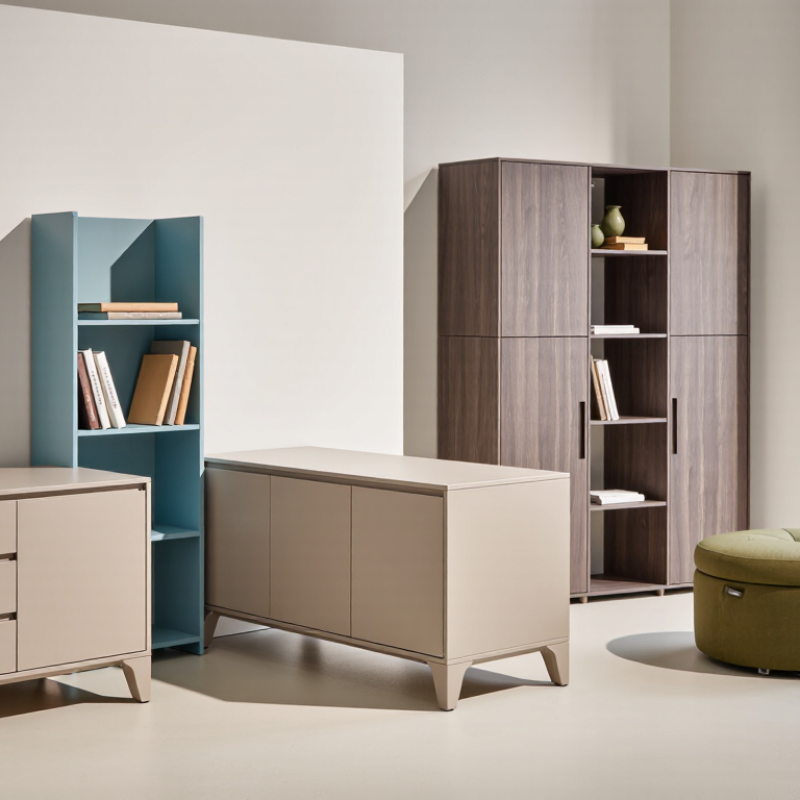
In 2026, powder-coated MDF furniture is leaning toward tactile surfaces, quieter colors, and clearer material choices. Warm gray, clay, olive, and chalky white suit compact kitchens and home offices. Fine-grain textures soften the clean look of flat panels. Subtle, not sterile. Rounded corners and slim, contrasting edges add definition without making a small room feel busy.

Material sourcing matters more as well. The United Nations Environment Programme’s Global Resources Outlook 2024 estimates that global resource extraction rose from 30 billion tonnes in 1970 to 106 billion tonnes in 2020. That scale makes recycled fiber, certified wood inputs, and durable panel construction worth asking about. Powder coating can create a consistent, hard-wearing surface, but performance depends on proper MDF preparation and curing. A smooth finish alone proves little.

For indoor furniture sold in the United States, EPA TSCA Title VI sets formaldehyde emission limits of 0.11 ppm for MDF and 0.13 ppm for thin MDF. These figures help buyers and designers compare panel specifications; they do not describe every indoor emission. Look for documented compliance and ask how exposed edges are sealed. That detail is easy to miss. I would also treat “easy to clean” claims carefully: textured finishes can hold dust in grooves, and real-life upkeep is not always as effortless as a showroom suggests.

Leading Color, Texture, and Form Trends for 2026

In 2026, powder-coated MDF furniture is moving toward colors that feel grounded rather than stark. Think mineral green, dusty terracotta, warm stone, and deep ink blue. The 2024 U.S. Kitchen Trends Study reported that wood cabinet choices rose from 21% to 25% among renovating homeowners. That shift suggests growing interest in surfaces with warmth and character, even when the material is engineered MDF. Color still needs testing under real room lighting.

Texture is becoming quieter but more tactile: fine-grain mattes, soft satin, and subtle ribbing can add depth without making a cabinet feel busy. Grand View Research valued the global furniture market at about $677 billion in 2024, reflecting a large and evolving sector. For powder-coated MDF, finish quality depends on suitable board preparation and coating processes; buyers should request samples and inspect edges closely. Small flaws show.

Forms are softening, too. Rounded corners, curved drawer fronts, and slim fluted details can make storage pieces feel less rigid. Yet texture is not automatically practical: deep grooves may collect dust, and very dark mattes can reveal fingerprints. A small sample helps. Compare it beside flooring and daylight before approving a full production run.

Popular Applications Across Homes and Commercial Spaces

In 2026, powder-coated MDF is appearing in more home interiors, especially where smooth color and easy-clean surfaces matter. Kitchen doors and wardrobe fronts can create a calm, consistent look, while bathroom vanities need suitable moisture-resistant cores and carefully sealed edges. Matte finishes soften bright rooms. Deeper colors add contrast to pale walls and timber floors. Small changes matter.

The finish is not magic. Edges can be vulnerable if moisture gets in, and heavy daily use may leave marks over time. For commercial spaces, powder-coated MDF suits reception desks, retail shelving, office storage, and café wall panels in lower-impact areas. It gives designers broad color choices without relying on natural wood grain. Durability still depends on the board grade, coating process, and installation. Ask for a physical sample, then check its color in the actual lighting. That extra step is easy to skip. Not every room is a good fit.

How to Choose Durable and Sustainable Powder-Coated MDF Furniture

How to Choose Durable and Sustainable Powder-Coated MDF Furniture

Durable powder-coated MDF furniture depends on the whole panel, not just its smooth finish. Check that edges are fully sealed; exposed MDF can swell after spills or humid conditions. Ask for adhesion and abrasion test results, such as ASTM D3359 and ASTM D4060. The U.S. EPA’s 1997 Powder Coatings: A Technology Overview reports powder-coating transfer efficiency can reach 95%. This is a process benchmark, not proof that a finished MDF product is sustainable. MDF also needs a compatible, carefully controlled curing process, so ask whether the panel and coating were tested together.

Tips: Inspect corners and drilled holes for thin coverage. Ask for FSC- or PEFC-certified wood sourcing, plus formaldehyde-emissions documentation. A product environmental declaration can help compare impacts, if available. Look closely. A flawless showroom sample may hide weak edges, and I would not assume a thick-looking coating means better protection. Ask how the finish performs under routine cleaning and light impacts, and whether damaged areas can be repaired rather than replacing the whole piece.