Choosing a UV Protection Golf Umbrella involves more than picking a wide canopy. On an exposed fairway, it can provide welcome shade during a slow round, especially near midday. A useful umbrella should balance coverage, wind handling, weight, and clear product information. That matters. Golfers carry it between shots, open it beside a bag, and may hold it for several holes.
Look for a stated UPF rating or clear details about the canopy’s UV-protective material, rather than relying on dark fabric or broad marketing claims. A larger canopy can shade your head, shoulders, and part of your golf bag, but it may feel awkward in gusts or tight spaces. Not completely. Umbrellas also cannot block every ray reflected from pavement, sand, or water, and sunlight reaches exposed skin from different angles. A hat, protective clothing, and sunscreen can still be useful companions.
This guide considers practical features, including canopy size, frame strength, handle comfort, and how easily the umbrella fits into a golf bag. It also separates stated specifications from features that need to be checked with the manufacturer. No single model suits every golfer. The best choice depends on your usual course conditions, how much weight you want to carry, and whether reliable shade matters more than compact storage. Some trade-offs are easy to miss in a product listing.
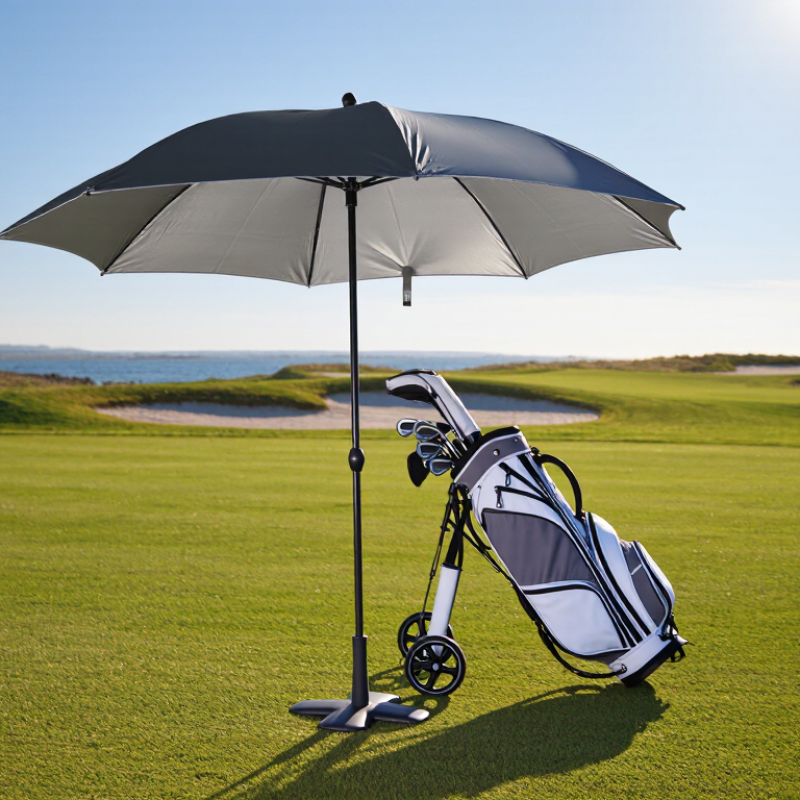
A UV-protection golf umbrella is defined by more than a dark canopy. Look for a stated UPF rating, which indicates how much ultraviolet radiation the fabric blocks under tested conditions. A clear rating is more useful than vague claims such as “sun safe.” Fabric density, coatings, and the condition of the canopy can all affect protection. Check the label. If the rating or test details are missing, treat the claim cautiously.
Coverage matters on the course. A wide canopy can shade your face, neck, and shoulders while you wait beside a tee box, but sunlight may still reach you from the sides or reflect off pale sand and pavement. Shade helps. Choose a sturdy frame and a handle that feels secure during long rounds; a loose grip gets tiring in humid weather. Vent panels can improve airflow, though they may also let some light through, depending on their design. I would not judge an umbrella by color alone: a black underside may feel cooler to the eyes, but it does not prove stronger UV protection. Ratings are helpful, yet fit and regular use matter too. An umbrella left in the golf bag offers little protection.
| Feature | What to Look For | Why It Matters | Practical Check |
|---|---|---|---|
| Verified UV rating | A clearly stated UPF rating, ideally UPF 50 or UPF 50+. | UPF measures how much ultraviolet radiation passes through fabric. UPF 50 allows about 1/50, or 2%, of UV to pass under the test conditions. | Look for a rating supported by a named test standard or laboratory result; do not rely only on phrases such as “UV coating.” |
| Fabric coverage | Dense, evenly woven canopy fabric with a documented UV rating. | Fabric construction, color, stretch, moisture, and wear can affect UV transmission. A dark color alone does not confirm a specific UPF. | Check the product information for the fabric’s tested rating and care instructions. |
| Canopy size | A broad canopy, often around 60–68 inches across the curved canopy measurement in golf-umbrella styles. | More coverage can shade the head, shoulders, and upper body, depending on the user’s height, sun angle, and umbrella position. | Confirm how the measurement is taken; canopy arc and open diameter are not the same measurement. |
| Side-angle shading | A canopy that can be positioned to shade the user as the sun moves. | Sunlight can reach skin from the side or reflect from nearby surfaces, even when the umbrella fabric blocks much of the overhead UV. | Choose a design that is comfortable to hold and reposition during a round. |
| Wind-resistant construction | A sturdy frame and a vented canopy, where appropriate. | Wind stability helps keep the canopy usable outdoors. A vent can let some air pass through, but it does not by itself establish UV performance. | Check frame materials, vent construction, and the maker’s wind-use guidance. |
| Open diameter and usable shade | Enough open-canopy width to shade the intended area without obstructing movement. | Published dimensions may describe the canopy arc, diameter, or another measurement, so numbers are not always directly comparable. | Compare the stated open diameter or ask how the size is measured. |
| Handle and grip | A comfortable, secure grip suited to carrying or mounting on a golf trolley. | A stable grip makes it easier to keep the canopy positioned over the body, particularly while walking or in changing conditions. | Check handle shape, length, and compatibility with any umbrella holder you plan to use. |
| Weight and portability | A weight that is practical to carry for a full round. | A larger canopy may provide more shade but can be heavier and harder to manage. | Compare the listed product weight as well as folded length and storage requirements. |
| Complete sun protection | Use the umbrella alongside a broad-brim hat, UV-protective clothing, sunglasses, and sunscreen on exposed skin. | An umbrella shades only part of the body and cannot eliminate UV exposure from reflected or scattered sunlight. | Reapply sunscreen according to its label and seek shade when possible, especially during periods of strong sun. |