Menu
Monday
9:00-5:00
Tuesday
9:00-5:00
Wednesday
9:00-5:00
Thursday
9:00-5:00
Friday
9:00-5:00
Saturday
9:00-4:00
Sunday
CLOSED
China’s playground accessories manufacturers serve a fast-changing global market. Their products include swings, slides, climbing panels, balance elements, sensory features, and inclusive play components. However, “top” should not mean the cheapest supplier. It should mean dependable design, consistent production, clear documentation, and practical after-sales support.
Simon Nicholson, an architect and pioneer of play-environment design, wrote, “In any environment, both the degree of inventiveness and creativity, and the possibility of discovery, are directly proportional to the number and kind of variables in it.” His words remain relevant today. Strong playground accessories should invite movement, imagination, and social interaction. They should also withstand repeated use, rain, ultraviolet exposure, and rough handling. Manufacturers must show how they manage material selection, edge finishing, drainage, anchoring, and quality inspection. Small details matter. A sharp corner does not belong near children.
This guide examines leading Chinese suppliers through a practical procurement lens. It considers product range, manufacturing experience, customization, safety testing, export capability, communication, and installation guidance. Factory visits, sample reviews, and independent verification can reveal more than polished catalogs. A supplier may offer attractive designs but weak instructions. Another may provide reliable components but limited creative options. Neither issue should be ignored.
The market is not perfect. Product claims still require careful checking. Buyers should confirm applicable standards for the destination country and the specific project. With thoughtful evaluation, China’s playground accessories manufacturers can support durable, engaging, and responsibly planned play spaces.
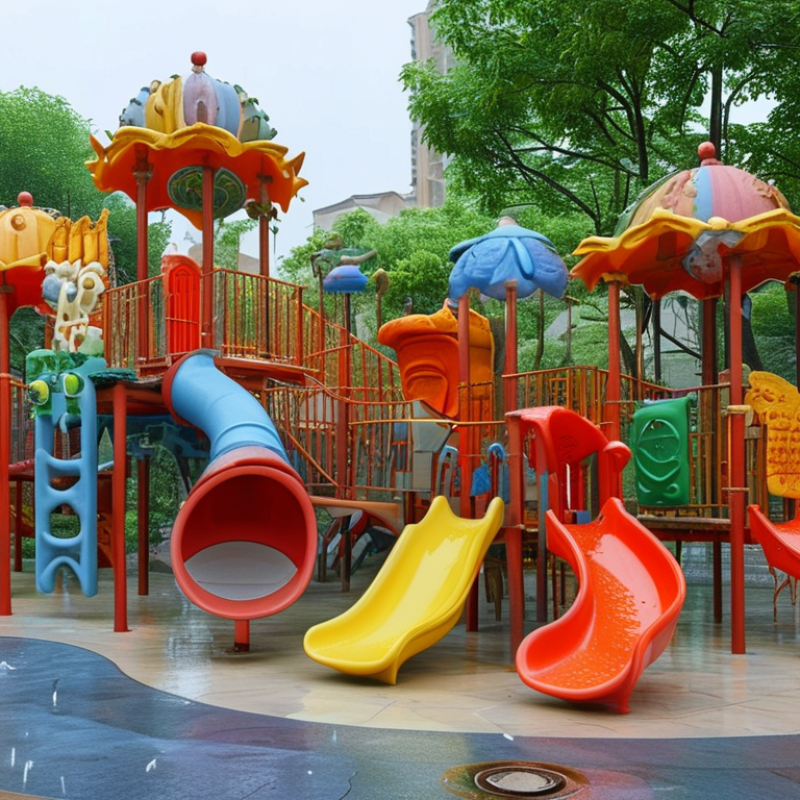
China's playground accessories manufacturing sector has grown from simple metal fabrication into a coordinated supply network. Factories commonly produce slides, climbing grips, swings, tunnels, shade parts, and sensory panels. Stainless-steel tubes, rotomolded plastic, and weather-resistant coatings support outdoor use. Experienced suppliers often combine design support with cutting, welding, molding, assembly, and export packing. Their real value appears in details: smooth welds, capped fasteners, accurate holes, and clear installation drawings. Product quality still varies widely between workshops.
Professional buyers should assess more than catalog size or price. Request material specifications, coating data, load-test records, and production samples. Independent inspections can verify dimensions, surface finish, packaging, and hardware counts before shipment. It also helps to review the factory’s quality procedures and traceability system. Standards such as EN 1176 or ASTM F1487 may guide project requirements, but local rules remain important. A quotation can look attractive while excluding anchoring, spare parts, or installation support. We sometimes overlook these omissions. That is an expensive lesson.
Tips: Ask for a sample before approving a large order. Confirm tube thickness, plastic thickness, UV resistance, and drainage design. Share the site’s climate, fall-zone layout, user age range, and maintenance plan. Photograph each packed carton. Keep signed drawings and inspection records. A supplier that answers technical questions clearly is usually easier to manage after delivery. Even careful teams should allow time for revisions.
China’s urbanization rate increased from 63.89% in 2020 to 67.00% in 2024. This national indicator provides demand context for playground accessories, public recreation equipment, and outdoor children’s facilities, although it is not a direct measure of industry sales or factory output.
Source: National Bureau of Statistics of China, annual urbanization data.
Chinese playground accessory manufacturers serve a wide export market, with products grouped by function, age range, and installation needs. Grand View Research valued the global playground equipment market at approximately USD 5.2 billion in 2023. It also projected steady growth through 2030. However, market figures vary because reports classify accessories differently.
Core categories include swings, slides, climbing frames, spring riders, and modular activity panels. Suppliers commonly offer stainless steel posts, powder-coated steel, rotomolded plastic, and treated timber options. Many factories also produce safety surfacing, shade structures, fences, benches, and outdoor fitness accessories. These supporting products matter. A slide alone does not create a usable play space.
Inclusive equipment is gaining attention. It may include wheelchair-accessible ramps, transfer platforms, sensory panels, and low-height activities. A 2024 industry analysis by Fortune Business Insights identified public recreation investment and inclusive design as important market drivers. Yet product catalogs can make accessibility look easier than it is. Buyers should request dimensional drawings, load testing records, material specifications, and maintenance guidance.
Chinese suppliers often support custom colors, themed shapes, container-based packaging, and mixed-product orders. Their practical advantage is usually manufacturing flexibility. Quality still depends on supervision. ASTM F1487, EN 1176, and local standards may require different details, so one certificate cannot answer every question. I have found that drainage, fastener protection, and replacement-part availability deserve more attention than attractive renderings. The small parts matter.
Choosing China’s top playground accessories manufacturers requires more than comparing catalog prices. Grand View Research valued the global playground equipment market at about USD 5.4 billion in 2023, with continued growth expected through 2030. That growth attracts capable factories, but also inconsistent suppliers. During evaluation, request factory records, material specifications, load tests, and recent export references. A serious manufacturer should explain steel grades, coating thickness, plastic safety, drainage, and replacement-part availability.
Safety evidence matters most. The U.S. Consumer Product Safety Commission reports roughly 200,000 emergency-department injuries linked to playground equipment annually. Ask whether products are tested against relevant standards, such as ASTM F1487 or EN 1176. Check the testing laboratory, report date, product model, and failed criteria. A certificate copied into a sales presentation proves little. Factory audits should also review welding quality, edge finishing, packaging, and worker inspection procedures. I have found that samples can look excellent while hidden welds remain uneven. That is an uncomfortable but important limitation.
Tips: Compare identical specifications, not only prices. Order a production sample before placing a large order. Measure tube thickness independently. Confirm installation drawings and maintenance instructions. Request photos from completed projects, then verify them. Evaluate communication speed and technical accuracy, because delays often begin with vague answers. No checklist is perfect. Recheck critical details before shipment.
China Top Playground Accessories Manufacturers?
Safety begins before a slide reaches a playground. The U.S. Consumer Product Safety Commission reports over 200,000 playground-related emergency visits each year. Falls cause most incidents. Manufacturers should therefore control both design and production.
Reliable Chinese suppliers test steel thickness, weld strength, surface coating, and plastic impact resistance. They should check sharp edges with gauges and test openings against head and finger entrapment requirements. ASTM F1487 and EN 1176 provide useful technical benchmarks. ISO 8124-4 also addresses safety requirements for activity toys. Standards are not decoration.
A strong factory keeps batch records for bolts, ropes, coatings, and molded parts. It should inspect welds visually and, when needed, through non-destructive testing. Impact-attenuation tests must match the planned surfacing. CPSC guidance highlights protective surfacing as a critical injury-control measure. A certificate alone is not proof of safe installation. That part is often overlooked.
During supplier audits, ask for recent test reports, calibration records, material declarations, and corrective-action logs. Check whether the same component matches the approved sample. Small changes can matter. A thinner tube, rougher weld, or weak anchor may create a serious failure. No factory is perfect, and inspection systems need regular review. Safety improves when manufacturers record defects honestly and correct root causes, not merely replace rejected parts.
| Safety or Quality Dimension | International Standard or Reference | Typical Requirements for Playground Accessories | Recommended Manufacturer Control | Objective Verification Evidence | Practical Importance |
|---|---|---|---|---|---|
| General playground equipment safety | EN 1176 Series | Addresses equipment design, installation, structural integrity, entrapment risks, falls, impact areas, protrusions, ropes, chains, and moving parts. | Perform design-risk assessments, prototype inspections, production inspections, and installation checks against the applicable parts of the EN 1176 series. | Technical drawings, risk-assessment records, material certificates, inspection reports, and test reports from a competent laboratory. | Provides a widely recognized framework for reducing foreseeable hazards in public playground equipment. |
| Impact-absorbing surfacing | EN 1177 | Defines methods for evaluating the critical fall height and shock-absorbing performance of playground surfacing. | Verify the surfacing system, thickness, drainage, installation depth, and performance beneath and around the accessory. | Critical fall height test report, installation specification, site inspection record, and maintenance log. | Helps limit head-injury risk associated with falls from accessible play components. |
| United States public playground equipment | ASTM F1487 | Covers public-use playground equipment, including structural design, dimensional requirements, entrapment, sharp points, projections, and use-zone provisions. | Review drawings and samples for dimensional compliance and conduct production conformity checks before shipment. | Engineering calculations, dimensional inspection sheets, component test records, and conformity documentation. | Useful when accessories are intended for public playgrounds in the United States. |
| U.S. playground safety guidance | CPSC Public Playground Safety Handbook | Provides guidance on layout, protective surfacing, use zones, maintenance, accessibility, and common hazards. | Use the handbook as a design and installation reference together with applicable mandatory requirements and consensus standards. | Site layout drawings, use-zone measurements, maintenance schedules, and hazard-correction records. | Supports safer planning, inspection, and maintenance of playground installations. |
| Children’s product material safety | ISO 8124-3 / ASTM F963 | Addresses migration or content limits for certain elements and, depending on the market, other toy-related safety requirements for accessible children’s products. | Control paint, coatings, plastics, rubber, and metal inputs; approve suppliers and test representative material batches. | Supplier declarations, laboratory chemical test reports, batch records, and approved-material lists. | Reduces the risk of restricted substances entering painted, coated, or molded accessory components. |
| Mechanical strength and durability | Applicable EN 1176 or ASTM F1487 clauses | Equipment and accessories should withstand expected user loads, repeated use, impact, vibration, and environmental exposure without hazardous failure. | Conduct static-load, fatigue, pull, torque, impact, and cyclic-use tests according to the product design and target market. | Load-test data, fatigue-test results, weld inspection records, and engineering calculations. | Identifies premature cracking, deformation, loosening, or structural failure before field installation. |
| Corrosion and weather resistance | Project specification and applicable coating standards | Metal parts should be protected against rust and coating breakdown appropriate to the intended climate and exposure conditions. | Control steel preparation, galvanizing or powder-coating processes, coating thickness, curing temperature, and surface defects. | Coating-thickness readings, salt-spray results where specified, galvanizing records, and visual inspection reports. | Extends service life and helps prevent sharp corrosion damage or loss of structural performance. |
| Entrapment and pinch-point prevention | EN 1176 / ASTM F1487 | Openings, gaps, moving joints, and access points must be assessed to reduce head, neck, finger, limb, and clothing entrapment hazards. | Inspect prototypes and finished products with calibrated gauges and review all moving interfaces throughout the full range of motion. | Gauge inspection records, dimensional drawings, risk assessments, and corrective-action reports. | Addresses hazards that may not be visible during a basic visual inspection. |
| Surface finish and user contact areas | Applicable playground safety clauses | Accessible surfaces should be free from sharp edges, burrs, exposed fasteners, dangerous projections, splinters, and peeling coatings. | Use first-piece approval, 100% visual and tactile inspection of user-contact areas, and controlled deburring and finishing procedures. | First-article inspection report, final inspection checklist, photographs, and nonconformance records. | Protects users from cuts, scratches, snagging, and clothing-related incidents. |
| Fasteners and connection security | Product engineering specification | Bolts, nuts, anchors, rivets, and other connections must be suitable for the loads, environment, and expected maintenance conditions. | Specify corrosion-resistant hardware, control torque values, use locking methods where required, and inspect anchor interfaces before dispatch. | Fastener certificates, torque records, incoming inspection reports, and installation instructions. | Reduces loosening, component separation, vandalism-related damage, and maintenance failures. |
| Dimensional and batch consistency | ISO 9001 quality-management principles | Critical dimensions, materials, colors, hole locations, and interfaces should remain consistent with approved drawings and specifications. | Maintain controlled drawings, inspection plans, calibrated measuring equipment, lot identification, and traceable corrective actions. | Inspection and Test Plans, calibration certificates, batch records, approved samples, and nonconformance reports. | Improves interchangeability, installation accuracy, and repeatability across production batches. |
| Packaging, transport, and installation information | Applicable product specification | Components should be protected from damage during transport and supplied with assembly, anchoring, use-zone, inspection, and maintenance information. | Use protective packaging, packing-list verification, installation drawings, hardware labeling, and pre-shipment inspection. | Packing photographs, carton or pallet checklists, installation manuals, and shipment-release records. | Prevents damage and assembly errors that could compromise safety after delivery. |
| Post-installation and periodic inspection | EN 1176-7 / CPSC guidance | Playgrounds require routine visual checks, operational inspections, and periodic detailed inspections based on use, environment, and risk. | Provide inspection intervals, replacement-part information, maintenance procedures, and clear reporting channels for defects. | Inspection forms, maintenance logs, repair records, and component replacement history. | Ensures that safe performance is maintained throughout the accessory’s service life. |
Sourcing playground accessories in China requires more than comparing catalog prices. In practice, I begin with one identical specification sheet for every supplier. It should include dimensions, material grades, colors, load requirements, installation details, and packaging expectations. This prevents attractive quotations from hiding different product standards.
A factory visit can reveal useful details. Look for organized welding areas, protected storage, incoming material checks, and clear quality records. Ask for production samples, surface-finish reports, structural test documents, and installation instructions. For outdoor parts, inspect UV resistance, drainage holes, rounded edges, fasteners, and corrosion protection. Request photos from recent projects, but verify them carefully. A polished catalog proves little.
I also compare communication speed and technical accuracy. Can the manufacturer explain tolerances, replacement parts, and lead-time risks? Can its engineers adjust a drawing without creating new safety problems? Small details matter. Packaging deserves attention too, because scratched panels and missing bolts can delay installation. I once focused too heavily on unit cost and underestimated inland transport, spare parts, and inspection fees. That mistake changed my comparison method. The lowest quote may not be the lowest project cost. Supplier claims still need independent checking, and even a strong sample cannot guarantee every production batch.