Menu
Monday
9:00-5:00
Tuesday
9:00-5:00
Wednesday
9:00-5:00
Thursday
9:00-5:00
Friday
9:00-5:00
Saturday
9:00-4:00
Sunday
CLOSED
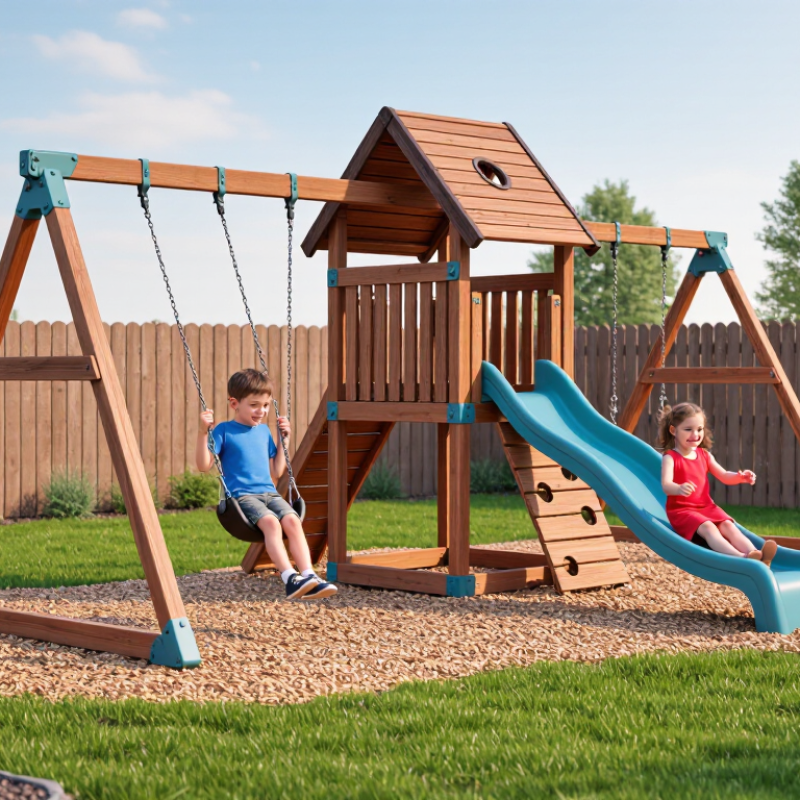
Choosing outside play sets is not just a matter of picking the biggest structure in the yard. A sturdy frame, secure anchors, and age-appropriate platforms matter more than extra features. So does the ground beneath it. Grass may look soft, but it does not reliably cushion a fall. The right choice should fit your children, available space, and willingness to inspect and maintain the equipment.
There is good reason to make outdoor movement part of family life. The World Health Organization’s 2020 Guidelines recommend that children and adolescents ages 5–17 average at least 60 minutes of moderate-to-vigorous physical activity daily across the week. A play set can support active play, but it cannot guarantee it. CPSC’s Public Playground Safety Handbook identifies falls as a major source of playground injuries and emphasizes protective surfacing and clear space around equipment. Its guidance concerns public playgrounds, so use it as a safety reference, not a substitute for the manufacturer’s home-use instructions.
Before buying, measure the yard and check for slopes, fences, branches, and overhead lines. Compare the set’s fall height, recommended safety zone, materials, hardware, and maintenance needs. Then consider how children may use it as they grow. A swing that delights a toddler today may feel limiting later. Bigger is not always better. And one detail is easy to miss: the safest set is the one adults can assemble correctly, inspect regularly, and keep in good condition.
Define Your Space and Choose Equipment for CPSC Age Groups 2–5 or 5–12
Start with a measured sketch of the yard, including fences, trees, doors, and slopes. Then mark the equipment’s full use zone, not just its footprint. The CPSC Public Playground Safety Handbook separates play equipment into age groups 2–5 and 5–12 because children’s abilities and equipment needs differ. A toddler-sized slide may suit preschoolers, while older children often need more challenging climbing features. Measure twice. A cramped layout can turn an inviting play area into an awkward one.
For ages 2–5, look for low platforms, easy-to-grip rails, and steps that match smaller bodies. For ages 5–12, consider varied climbing routes and higher activity structures, while checking the maker’s age guidance. Leave clear space around swings and slides, and keep moving play away from hard edges. The CPSC handbook’s surfacing table reports that 9 inches of engineered wood fiber can provide impact protection for falls up to 10 feet when properly installed and maintained. That detail matters.
Choose surfacing for the actual fall height, and plan to refill or redistribute loose material as it shifts. Check the site after rain, too; puddles and soft ground can change how the area feels underfoot. A paper plan may look generous, yet a gate swing or overhanging branch can steal useful space. It is easy to miss.
Cite: U.S. Consumer Product Safety Commission, Public Playground Safety Handbook, Publication 325.
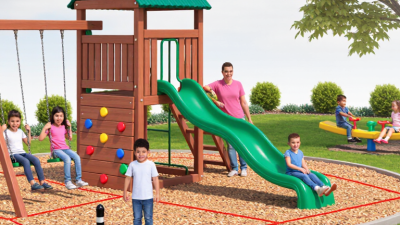
A home play set should offer more than a sturdy appearance. Check whether its documentation specifically references ASTM F1148, the safety performance standard for home playground equipment. Ask for the applicable edition and written evidence tied to the exact model you plan to buy. A general “meets safety standards” statement is less useful. Paperwork matters.
Look for details on structural strength, openings that could trap a child, sharp edges, and protruding hardware. The standard is one useful check, not a promise that injuries cannot happen. Confirm the set suits your children’s ages, and check its installation instructions, anchoring requirements, and recommended fall zone. Measure the yard before ordering; a play set that fits on paper may crowd a fence or patio. I’d also pause if the seller cannot explain its safety claims clearly.
Tips: Request the test report or written compliance statement, and match its model number to the product. Check that bolts sit flush and the frame is anchored as instructed. Choose appropriate impact-absorbing surfacing, then inspect the equipment regularly. Standards help, but real yards and family routines vary.
How to Choose the Best Outside Play Sets?
A safe play area begins with space, not the equipment itself. CPSC guidance recommends a clear use zone of at least six feet around most playground equipment. Measure from the equipment’s outer edges, then check for fences, tree trunks, walls, and garden borders. A tape measure helps; guessing from a photo does not. Small shifts matter. For swings, allow extra room in front and behind: guidance commonly calls for a zone extending twice the pivot-point height.
Tips: Mark the planned boundary with garden hose or chalk before installation. Check the whole area at ground level, including spots where a child might land. Follow the equipment’s instructions, since some designs need more clearance than the general guideline. Don’t treat six feet as a guarantee of safety.
Also inspect the landing surface. Grass can hide hard soil, roots, or stones, and it may not cushion a fall reliably. Use an appropriate impact-absorbing surface and keep it maintained at the depth recommended for the equipment. Recheck measurements after assembly; posts can shift the layout, and a level that looked generous on paper may feel tight in the yard. I’ve found that measuring twice is worthwhile, though it is easy to overlook the space needed for adults to supervise and children to move around.
A play set’s fall height is only part of the safety picture. The surface beneath it matters too. ASTM F1292 tests how well playground surfacing reduces impact, using a standardized instrumented headform dropped onto the material. Results include Head Injury Criterion (HIC) and peak acceleration. The standard’s commonly referenced limits are HIC 1,000 and 200 g. These are test thresholds, not promises that a child will avoid injury.
Ask for test results that match the installed surface, its depth, and the equipment’s fall height. A lab result for loose-fill material may not represent a compacted, wet, or poorly maintained playground. The U.S. Consumer Product Safety Commission’s Public Playground Safety Handbook advises protective surfacing around equipment and emphasizes maintaining it. A shallow patch under a swing can expose hard ground; check high-use landing zones after rain and heavy play. Numbers matter.
Compare surfaces by verified performance, upkeep, drainage, and accessibility—not by appearance alone. Request the report date and test conditions, then confirm that the installer’s material and depth match them. ASTM results help make comparisons fair, but they cannot account for every real-world fall. I would still inspect the surface regularly; that practical step is easy to overlook.
Compare the installed surfacing system with the play equipment’s fall height. ASTM F1292 performance must be verified with test data for the specific product and installation; material type alone does not establish impact performance.
| Surfacing type | ASTM F1292 data to check | What the test result means | Practical selection considerations |
|---|---|---|---|
| Engineered wood fiber (EWF) | Request the tested critical fall height and the tested installed depth for the exact EWF product. | The report should show that the system meets the applicable impact-attenuation limits at the stated fall height. | Loose fill can migrate or compact, so depth and coverage need regular inspection and replenishment. |
| Loose-fill rubber mulch | Check the product-specific test report, including tested depth and critical fall height. | Results apply to the tested material and installation conditions, not automatically to all rubber mulch. | Plan for displacement, edging, and maintenance; keep the required protective depth throughout the use zone. |
| Poured-in-place rubber | Request test data for the specified system build-up, including wear layer, cushion layer, and installation thickness. | A tested result for one thickness or system configuration should not be assumed to apply to another. | A continuous surface can support access routes, but seams, wear, repairs, and drainage should be considered. |
| Rubber tiles or mats | Verify the tested tile system, thickness, substrate, joints, and critical fall height. | The performance of a tile alone may not represent the complete installed surface assembly. | Check that tiles remain securely joined and level, and inspect for gaps, lifting, or damaged areas. |
| Sand or pea gravel | Use test data for the specified material and depth; do not infer performance from the material name. | Impact attenuation depends on the tested and maintained condition, including depth and material characteristics. | Loose fill may shift and require frequent leveling; consider accessibility, drainage, and potential ingestion or scattering. |
| ASTM F1292 acceptance benchmarks | Head Injury Criterion (HIC): 1,000 or less; peak acceleration: 200 g or less. | These are impact-attenuation criteria used in the standard’s test evaluation; they are not a guarantee against injury. | Choose a system whose documented critical fall height is at least the equipment’s fall height, and maintain it as installed and tested. |
Before purchasing: Ask for the ASTM F1292 test report identifying the tested surfacing product or system, installation depth or thickness, substrate where applicable, and critical fall height. Confirm the report matches the planned installation and follow the surfacing manufacturer’s inspection and maintenance instructions.
An outside play set can look roomy until a swing starts moving. Check its full travel area before choosing a location. The U.S. Consumer Product Safety Commission’s Public Playground Safety Handbook recommends a swing use zone extending at least twice the pivot height in front of and behind the swing. With a pivot 7 feet above the ground, that means 14 feet of clearance in each direction, measured horizontally from the point beneath the pivot. Measure twice.
Keep that zone clear of fences, tree trunks, walls, and other play equipment. A tape measure and a few temporary markers make the space easier to judge. Check the ground for slopes, too: a swing’s path may look level while the landing area is not. Keep it open.
The CPSC handbook addresses public playgrounds, so treat its dimensions as a careful planning benchmark for a home set, not a substitute for the equipment maker’s instructions. Also check the relevant residential play-equipment standard, ASTM F1148, and follow the set’s specified installation clearances. Recheck after assembly; posts or seats can shift slightly as hardware is tightened. It is easy to underestimate the space a swing needs, especially in a narrow yard. That deserves a second look.